The real cost of cheap tools extends far beyond replacement price. Lost hours, botched jobs, and damaged professional reputation add up quickly, especially in an industry where reliability defines success. The construction and landscaping sectors continue to grow, but so do client expectations for quality and speed.
This guide covers the essential categories of heavy-duty tools every professional contractor and landscaper needs in 2026—focusing on materials, durability, and job site performance rather than big-box retail brand names.
Key Takeaways
- Professional tools use superior materials (chromoly steel, aircraft aluminum, fiberglass) that consumer-grade options can't match
- Five critical tool categories covered: digging/ground prep, striking/demolition, landscape edging/hardscape, cutting, and material handling
- Cheap tools create hidden costs through replacement cycles, productivity loss, and job delays
- Hand tools drive job quality — the right one prevents rework, protects finishes, and keeps crews moving
- Buy through specialty trade suppliers, not chain retailers, for the most durable options
What Sets Heavy-Duty Professional Tools Apart
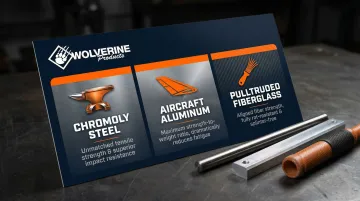
The difference between professional-grade and consumer-grade tools comes down to raw materials. Professional tools use chromoly steel instead of mild steel, aircraft-grade aluminum instead of standard alloy, and pulltruded fiberglass instead of wood composites. These materials hold up under daily job site stress in ways consumer-grade equivalents simply don't.
Each material brings something specific to the job:
- Chromoly steel blends chromium and molybdenum alloys to boost tensile strength and impact resistance — useful when a shovel blade hits rock or compacted clay hundreds of times a day
- Aircraft aluminum delivers a superior strength-to-weight ratio, cutting operator fatigue without sacrificing durability
- Pulltruded fiberglass aligns glass fibers along the handle's length during manufacturing, producing exceptional strength while eliminating the rot and splintering common with wood
A heavy-duty tool should handle repeated, high-force use across an 8-10 hour workday without deforming, splitting, or losing its edge. The construction industry sees tool loss rates between 30% and 50% on large projects, but implementing managed tool solutions and buying professional-grade equipment can reduce that loss to under 7%.
The sections below break down the specific tool categories that belong in every professional's truck or trailer in 2026, and what to look for within each one.
Heavy-Duty Tools Every Pro Needs in 2026
These five categories were chosen based on frequency of use across contracting and landscaping trades, the high rate of failure when using consumer-grade substitutes, and the direct impact each tool type has on project speed and quality.
Professional Digging, Grading & Ground Prep Tools
Shovels, spades, and tampers are the workhorses of landscaping and site prep—tools used hundreds of times per job. The blade-to-handle connection is the #1 failure point. Professional-grade digging tools use solid shank or closed-back construction with hardwood or fiberglass handles rated for contractor use.
Key specs to look for include blade steel gauge, handle material (ash/hickory vs. fiberglass vs. hollow metal), overall weight for fatigue reduction, and grip design for all-day use.
Wolverine Tools' contractor shovel line is purpose-built for this workload—designed and produced in-house using chromoly steel and pulltruded fiberglass. Trenching shovels feature 14-gauge heat-treated chromoly steel blades, among the highest gauge ratings available in professional contractor lines.
- Closed-back design with welded back plates prevents material buildup
- Two-rivet head attachments distribute stress across multiple connection points
- Pulltruded fiberglass handles resist splitting and flex fatigue under repeated impact
| Key Feature | Look for | Avoid |
|---|---|---|
| Blade Material | Chromoly or high-carbon steel | Standard mild steel |
| Handle Construction | Solid ash/hickory hardwood or pulltruded fiberglass | Hollow metal |
| Blade-to-Handle Connection | Solid or closed-back shank with reinforced collar | Open-back or epoxy-only attachment |
Striking & Demolition Tools
Sledgehammers, mattocks, breaker bars, and pry bars break up hardpan soil, remove pavers, and demolish concrete edging on construction and landscaping sites. Handle material is critical—fiberglass or hickory handles absorb shock and resist breakage far better than hollow steel or cheap composites.
Look for head weight range for different tasks (from 3 lb. hand maul to 16 lb. sledge), balance point, eye construction (steel-through vs. fiberglass-through), and anti-vibration features. Repetitive strain injuries and hand-arm vibration exposure are serious occupational hazards in trades, making proper tool selection essential for long-term health.
| Key Feature | Look for | Avoid |
|---|---|---|
| Head Weight | Match weight to task: 8-12 lb for general demolition, 3-6 lb for precision striking | One-size-fits-all approach |
| Handle Material | Hickory or fiberglass | Hollow steel (no shock absorption) |
| Head Attachment | Steel-through-handle or mechanically fastened | Epoxy-set heads |
Landscape Edging & Hardscape Installation Tools
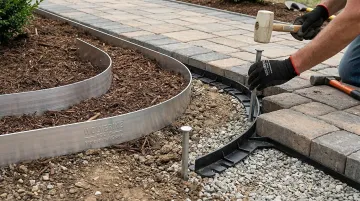
Edging, paver installation, and border work require tools built to precision standards. The difference between a clean finished edge and a wavy, unprofessional result often comes down to the quality of the edging and installation tools used. Aluminum and steel edging tools must resist bending under the force of compaction or soil pressure.
This category includes manual edgers, steel and aluminum edging strips, paver restraints, border stakes, and installation accessories. Wolverine Tools offers a professional-grade line of aluminum edging, steel edging, and aluminum paver restraints—designed and produced in-house, sold exclusively through wholesale landscape suppliers and professional trade channels rather than big-box retail. That exclusive channel means products are built to contractor tolerances—not sized down to homeowner DIY specs.
| Key Feature | Look for | Avoid |
|---|---|---|
| Edging Material | Commercial-gauge steel or aircraft aluminum | Thin-gauge aluminum sold at consumer retailers |
| Paver Restraint Construction | Aluminum restraints with spike spacing rated for commercial installations | Generic consumer-grade restraints |
| Stake Compatibility | Systems designed for easy installation in hard soils without deforming the edging profile | Flimsy stakes that bend on first use |
Heavy-Duty Cutting & Pruning Tools
Cutting tools see daily use on landscaping and contracting sites: loppers, pruning saws, utility blades, and hand-held cutting tools. For power cutting (reciprocating saws, circular saws, angle grinders), key performance benchmarks include blade RPM, amperage for corded tools, and battery voltage for cordless models.
Cutting tool quality shows itself over time through blade retention, handle durability under torque, and ease of blade replacement or sharpening. For hand cutting tools, forged blades outperform stamped blades. Blade and cutting tool failures contribute significantly to job site injuries, making quality selection a safety issue as much as a performance concern.
| Key Feature | Look for | Avoid |
|---|---|---|
| Blade Construction | Forged or precision-ground blades | Stamped-steel cutting edges |
| Handle Grip | Non-slip grip rated for wet/gloved use | Smooth plastic that slips when wet |
| Power Tool Voltage (if cordless) | 18V-60V brushless motor platforms for professional workloads | 12V or lower consumer platforms |
Landscape Rakes, Forks & Material Handling Tools
Rakes, forks, and material handling tools are among the highest-frequency items on any landscaping or nursery site. A crew using a landscape rake for eight hours puts enormous stress on both the head-to-handle connection and the tine welds—failures that consumer-grade tools can't withstand.
Professional rakes and forks are built with heavier-gauge steel tines, reinforced collars, and handles matched to the task load:
- Landscape rakes: Wide head spans (24–30 in.) for efficient grading and debris clearing
- Digging forks: Forged or solid-shank tines for breaking hardpan and turning heavy soil
- Brooms and scoops: Commercial-gauge for bulk material movement without flex or handle torque
- Nursery equipment: Ball carts and utility wagons designed for plant weight loads, not DIY hauling
Wolverine Tools' rake and fork line is produced in-house, using the same chromoly steel and hardwood handle standards as their shovel line—giving crews a consistent material quality across the full hand tool set.
| Key Feature | Look for | Avoid |
|---|---|---|
| Tine Construction | Forged or solid-shank steel tines | Stamped or welded wire tines |
| Head-to-Handle Connection | Reinforced collar with mechanical fastening | Friction-fit or epoxy-only collar |
| Handle Material | Ash, hickory, or pulltruded fiberglass | Hollow metal or pine dowel |
How to Choose Heavy-Duty Tools That Won't Let You Down
The biggest mistake professionals make when buying tools is optimizing for upfront price instead of total cost of ownership. A tool that costs twice as much but lasts ten times longer—and never fails on a job—delivers far better value. Calculate replacement cycles and lost productivity when evaluating cost.
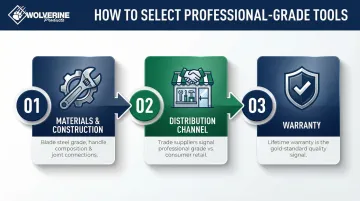
Three criteria separate pro-grade tools from the rest:
Materials and construction method — What is the tool actually made of? Check blade steel type, handle material, and connection methods.
Distribution channel — Professional-grade tools are sold through trade supply channels, not consumer retail. Landscape and contractor suppliers carry versions built for daily field use — heavier gauge steel, reinforced handles, and construction methods that simply aren't available at a big-box store.
Warranty — A lifetime warranty against manufacturer defects signals a brand's confidence in their product. In 2023, Fastenal repaired over 56,000 tools for customers, demonstrating the massive lifecycle value of serviceable, professional-grade tools over disposable consumer models.
These criteria also expose one of the most common buying mistakes: assuming a brand name at a big-box store equals professional quality. Many brands sell consumer and professional versions under the same name — and they look nearly identical on the shelf. The difference shows in the specs, handle material, and whether the tool was designed for daily heavy use or the occasional weekend project.
Conclusion
The difference between a tool that lasts a season and one that lasts a career comes down to three things: materials, construction integrity, and whether it was designed for a professional's daily workload — not a weekend DIYer's.
Across the five categories covered here — digging, striking, edging and hardscape, cutting, and power tools — every strong recommendation shared one trait: it was built with no compromises on the spec sheet. That's what separates tools worth buying from tools worth replacing.
If you're sourcing hand tools, digging equipment, edging, or paver installation tools, Wolverine Tools has manufactured professional-grade options since 1994. Their products use chromoly steel, aircraft aluminum, and pulltruded fiberglass — and every tool carries a lifetime warranty against manufacturer defects. Available through professional wholesale landscape suppliers and trade channels. Reach them at info@wolverinehandtools.com or 1-800-787-3562.
Frequently Asked Questions
Frequently Asked Questions
What are the top 10 power tools?
The heavy-duty tools professionals rely on most span both power and hand categories. On the power side: hammer drill, impact driver, reciprocating saw, circular saw, and angle grinder. On the hand tool side: contractor spades, digging bars, landscape rakes, tampers, and trade-specific shovels. The right mix depends on your trade and the physical demands of your daily work.
What tool brand do most contractors use?
Milwaukee, DeWalt, and Makita dominate the power tool market on commercial job sites, with brand loyalty often split by trade. For professional hand tools, brands like Wolverine Tools supply landscape contractors, nursery crews, and hardscape pros through wholesale distributors and hardware stores. The common thread across all of them: tools built for daily professional use, not occasional home projects.
What makes a tool "heavy-duty" vs. standard grade?
Heavy-duty tools are built from higher-grade materials—chromoly steel, aircraft aluminum, pulltruded fiberglass, and hardwoods like ash or hickory—and designed for repeated high-force daily use. Consumer-grade tools use standard materials suited for occasional home use, not the punishment of professional job sites. Lifetime warranties are a reliable indicator: brands that back their tools unconditionally are building to a different standard.
How long should professional-grade hand tools last?
A properly maintained professional-grade hand tool should last the career of the person using it. Wolverine Tools backs every tool with a lifetime warranty against manufacturer defects—because tools built from chromoly steel and aircraft aluminum shouldn't need replacing. That's the gap between a professional tool and a consumer product.
Are hand tools still important when power tools are available?
Hand tools remain essential on professional job sites for precision work, confined spaces, and tasks where power equipment would be impractical or damaging. This is particularly true in landscaping, hardscape installation, and finish work where control matters more than speed.
Where should professionals buy heavy-duty tools?
Professional contractors should buy through wholesale landscape suppliers, trade-specific distributors, or local hardware stores that carry contractor lines—rather than big-box consumer retailers. This ensures access to tools built and rated for professional daily use with proper specifications and warranty support.