Introduction
On a professional job site, a broken or low-quality tool doesn't just slow work down. It costs the crew time, money, and client trust. When a shovel blade folds under load or a handle snaps mid-dig, the entire schedule shifts. The crew waits. The client notices. And the contractor absorbs the cost of replacement, lost productivity, and damaged reputation.
This guide is written for professional landscapers and contractors, not weekend hobbyists. It covers the must-have tool categories for 2026, what separates professional-grade from consumer-grade tools, and what to look for when building out or upgrading a crew's toolkit.
A tool that lasts a season versus one that lasts a decade comes down to steel grade, handle construction, and how the product was sourced — not what the packaging claims at a big-box retailer.
Key Takeaways
- Professional landscapers need purpose-built tools engineered for daily commercial workloads, not hardware-store versions
- Essential categories include digging spades, rakes, edging tools, pruners, loppers, wheelbarrows, and hand trowels
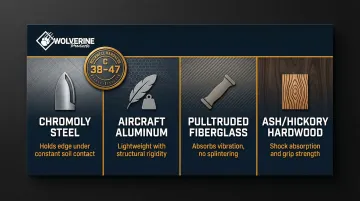
- Material matters: chromoly steel, aircraft aluminum, pulltruded fiberglass, and ash or hickory handles define durability
- Cheap tools cost more long-term through frequent replacements and job-site failures
- Buy through wholesale landscape suppliers or local hardware stores — not big-box retailers — to get contractor-grade tools that actually last
What Sets Professional-Grade Landscaping Tools Apart
The boundary between consumer-grade and professional-grade landscaping tools isn't marketing—it's material integrity and engineering. Commercial landscaping involves repetitive, high-load use that consumer tools aren't built to survive. A landscaper using the wrong grade of tool faces constant replacements, mid-job failures, and crew downtime that cuts into job profitability.
Material specifications define professional-grade durability:
- Chromoly steel blades hold a sharp edge under constant soil contact without degrading
- Aircraft aluminum keeps structural parts like edging and paver restraints light without sacrificing rigidity
- Pulltruded fiberglass handles absorb vibration and flex without splintering over time
- Ash or hickory hardwood handles deliver traditional shock absorption and grip strength
No universal public standard defines "professional-grade" hand tools, so buyers must rely on strict material specifications rather than retail labels. The USDA Forest Service and Federal specifications provide baselines: 12- to 14-gauge steel blades with Rockwell C 38-47 hardness, dual-riveted ash or fiberglass handles, and reinforced socket construction.
In-house design, tooling, and production control the full manufacturing process—which means blade forging, handle construction, and final assembly all happen under one roof. When manufacturers outsource to lower-cost facilities, quality becomes variable and tolerances drift. Wolverine Tools has maintained in-house manufacturing since 1994, controlling every stage of production to deliver tools that hold up on professional job sites.
That manufacturing discipline backs up a lifetime warranty against manufacturer defects. It's a direct statement about material confidence—and an expectation that the tool will outlast consumer-grade alternatives by years, not months.
The Best Landscaping Tools for Professional Crews in 2026
Professional landscaping crews don't buy tools by brand recognition—they buy by what survives daily abuse. The categories below are evaluated on durability, ergonomics, task efficiency, and material quality.
Contractor Shovels & Spades
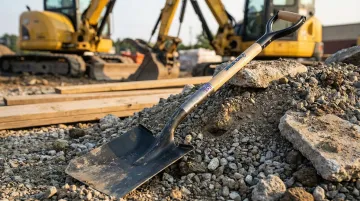
The shovel remains the single most-used and most abused tool on any landscaping job site. It handles soil moving, bed prep, planting, and excavation across every project type. Most failures occur at the handle-to-blade connection, making material and manufacturing quality critical.
OSHA explicitly warns that wooden handles must not be splintered or loose, as the head of the tool may fly off and strike workers.
Professional procurement should mirror the USDA Forest Service Specification for solid shank shovels: AISI/SAE 1060, 1050, or 5150 carbon steel with Rockwell C 38 to 47 hardness, minimum 0.069-inch blade thickness (14-gauge), and dual-riveted ash or fiberglass handles.
Wolverine Tools' contractor shovels have been manufactured to these professional-grade specifications since 1994, using 14-gauge tempered steel blades, two-rivet head-to-neck attachment, and Northern Ash or solid-core fiberglass handles. This construction prevents blade folding and handle separation under commercial leverage—exactly what separates a contractor shovel from a hardware-store replacement.
| What to Look For | Common Failure Points to Avoid | Best Use on the Job |
|---|---|---|
| Full-tang or solid-socket construction, chromoly or hardened steel blade, ash/hickory or fiberglass handle, anti-roll collar | Hollow-back blades, thin-gauge steel, plastic or low-grade aluminum sockets, stapled handle collars | Soil moving, bed edging, plant installation, hardscape base prep |
Landscape Rakes
Professional landscaping requires distinct rake profiles for different tasks. Bow rakes (or level head rakes) feature short, thick, widely spaced metal tines designed for leveling dirt, spreading mulch, and breaking up compacted soil. Leaf rakes use flexible tines (polyresin, bamboo, or light metal) for gathering debris without damaging turf.
Rake tine gauge and head-to-handle attachment method determine longevity under daily commercial use. Professional-grade rakes use heavy-gauge steel tines (not lightweight aluminum that bends under load) and reinforced head brackets with multi-bolt or riveted connections—not single-rivet designs that loosen over time.
| Key Spec | Avoid | Pro Tip |
|---|---|---|
| Heavy-gauge steel tines, reinforced head-bracket, fiberglass or hardwood handle, appropriate tine width for task | Lightweight aluminum tines that bend under load, single-rivet head connections | Have both types in the truck—a bow rake and a shrub rake serve entirely different functions on the same job |
Edging Tools & Lawn Edgers
Clean edging defines professional landscaping. Crisp bed lines and defined borders are what clients see and judge. Proper lawn edging creates a sharp, polished look that separates grass from flower beds and walkways, significantly enhancing curb appeal and perceived professionalism.
Manual half-moon edgers provide precision for bed perimeters, rotary edgers handle path and walkway lines, and flat-spade edgers cut bulk bed borders. Professional edgers use high-carbon steel (such as 1075 steel) heat-treated to Rockwell C 50-60 hardness, providing extreme wear resistance when striking pavement or roots.
Wolverine Tools' aluminum and steel edging products, along with aluminum paver restraints, cover the full range of professional border and hardscape containment—from bed perimeters to paver installations requiring rigid retention.
| What to Look For | Avoid | Best Use on the Job |
|---|---|---|
| Hardened steel blade, reinforced footrest, straight fiberglass or steel handle, consistent blade angle | Thin rolled-steel blades that fold under foot pressure, soft handles that torque | Bed perimeters, lawn-to-hardscape transitions, paver and edging installation |
Pruners, Loppers & Cutting Tools
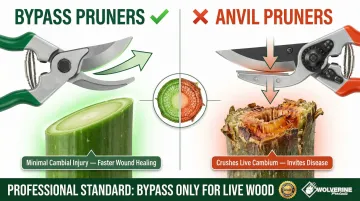
Every pro crew must carry three cutting tools: bypass hand pruners (for live stems up to ¾"), loppers (for branches up to 2"), and a quality pruning saw (for larger limbs). Bypass-style cutting (two blades passing) is the professional standard over anvil-style for clean cuts that don't crush plant tissue.
Studies confirm that double-bladed/bypass tools cause less cambial injury and promote faster wound healing compared to anvil shears. Anvil pruners crush live cambium, delaying wound closure and inviting disease. Crews should standardize on bypass pruners for all live-wood applications.
| Key Spec | Avoid | Pro Tip |
|---|---|---|
| Hardened steel blades, replaceable blade design, ergonomic grip, gear-assisted loppers for extended branches | Anvil-style pruners for live wood, non-replaceable blades, hollow handles | Sharpen blades weekly during heavy-use seasons—a dull cutter creates ragged cuts that invite disease |
Wheelbarrows & Material Movers
Wheelbarrow selection directly impacts crew efficiency. Volume capacity (6 vs. 8 cu. ft.), tray material (poly vs. steel), and pneumatic tire quality determine how much material a crew can move per hour. Contractor-grade wheelbarrows have welded steel frames, not bolted assemblies, and feature dual-ply tires rated for heavy loads.
Federal Specification KKK-W-291G requires contractor wheelbarrows to have minimum 0.0598-inch steel tray thickness (16-gauge), axles not less than 1/2 inch diameter, and tires with a minimum 2-ply rating. Large-capacity industrial wheelbarrows cut the number of trips per load—a meaningful efficiency gain across a full day of mulch or aggregate work.
| Key Spec | Avoid | Best Use on the Job |
|---|---|---|
| 6–8 cubic foot capacity, welded steel frame, pneumatic or flat-free tires, balanced center of gravity | Single flat tire, light-gauge pressed-metal tray, loose handle-to-tray connections | Mulch/soil transport, debris removal, hardscape material staging |
Hoes, Cultivators & Hand Trowels
The day-to-day working tools often get underbought: the stirrup hoe for weed disruption, the cultivator for bed prep and aeration, and the hand trowel for planting and transplanting. For hand tools especially, handle length and grip shape have an outsized impact on end-of-day fatigue—yet most purchasing decisions ignore both.
Professional-grade hoes and cultivators use forged or stamped steel heads with secure handle ferrules and ergonomic D-grips or straight handles matched to task type. Handle length should vary by application—short-handled versions for precision work, long-handled for standing cultivation.
| Key Spec | Avoid | Pro Tip |
|---|---|---|
| Forged or stamped steel heads, secure handle ferrule, ergonomic D-grip or straight handle by task type | Painted-over welds hiding poor joins, hollow handles, mismatched handle diameter to head weight | Stock a range—crews that use one handle length for everything end up compensating with posture, accelerating fatigue by midday |
How to Choose the Right Landscaping Tools for Your Crew
The most common buying mistake: selecting tools based on price-per-unit or retail availability rather than cost-per-year-of-use. A professional-grade tool purchased once at a higher price point eliminates the recurring cost of consumer-grade replacements and the productivity loss from mid-job failures.
The landscaping services industry (NAICS 561730) averages only 2.1 workers per business, indicating a high prevalence of solo operators and small crews. This makes individual tool accountability and standardized inventories essential for preventing loss and ensuring every crew member has the right tool for the task.
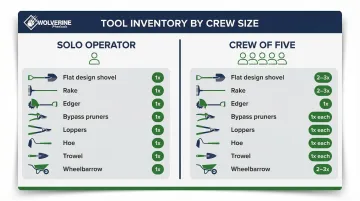
Match tool specs to crew size and job type:
- Solo operators need one of each core tool: shovel, rake, edger, pruners, loppers, hoe, trowel, and wheelbarrow
- Crews of five should run 2-3 shovels and rakes, 2-3 shared wheelbarrows, and individual pruners and hand tools per member
Standardizing tool brands and handle lengths reduces crew training friction and simplifies replacement part inventory. When every shovel uses the same handle type, swapping it out takes minutes, not a trip to three different suppliers.
That consistency also makes sourcing easier. Professional wholesale landscape suppliers, garden centers, and local hardware stores carry contractor-grade product lines—built to consistent specs with materials like chromoly steel and fiberglass handles—that big-box chains simply don't stock.
Caring for Your Landscaping Tools to Maximize Their Lifespan
End-of-day tool care is a non-negotiable professional habit. Knock off soil from blades, wipe metal surfaces to prevent rust, and store tools off the ground in a dry environment. Even the best professional-grade steel will corrode with neglect.
That daily routine keeps tools clean — but sharpness and structural integrity require their own attention.
Blade Edge Maintenance
- Sharpen cutting tools (pruners, loppers, edgers) weekly during peak season or after every 8-10 hours of active use
- Maintain the factory bevel (typically 20-25 degrees for pruners, 45 degrees for shovels) using a mill file or whetstone
- Remove burrs with 300-grit sandpaper after sharpening
Handle Maintenance
- Check for cracks or splits in wooden handles seasonally
- Treat ash and hickory with boiled linseed oil to prevent drying and dangerous splinters
- Inspect fiberglass handles for delamination or stress fractures at the ferrule junction
Run a pre-season audit before the busy period hits: inspect, sharpen, and swap out worn tools before they fail on a client job. Well-maintained tools also hold up under warranty review — documented care supports valid claims when you need them.

Conclusion
Professional landscapers who invest in properly specified, contractor-grade tools—and maintain them consistently—will outperform those who cut corners on equipment. The upfront premium offsets replacement costs, prevents job-site failures, and removes the risk of equipment breaking when the crew needs it most.
Evaluate your current toolkit honestly and replace consumer-grade tools with professional-grade equivalents through qualified suppliers. Wolverine Tools has manufactured contractor-grade hand tools since 1994, building products from materials that hold up under daily professional use:
- Chromoly steel for blades and digging heads
- Aircraft aluminum for lightweight, high-strength components
- Pulltruded fiberglass handles for impact resistance
- Ash or hickory hardwoods for traditional tool handles
Wolverine products are available through wholesale landscape suppliers, garden centers, and local hardware stores—and every tool carries a lifetime warranty against manufacturer defects. For product information or to find an authorized distributor, contact Wolverine Tools at 1-800-787-3562 or info@wolverinehandtools.com.
Frequently Asked Questions
What is the difference between professional-grade and consumer-grade landscaping tools?
Professional-grade tools use superior materials — chromoly steel, aircraft aluminum, hardwood handles — and are built for daily commercial workloads. They're distributed through professional wholesale channels, not big-box retail, because those channels carry product lines engineered to standards consumer tools simply don't meet.
What hand tools should every professional landscaper have in their truck?
The core kit covers the majority of professional applications:
- Contractor shovel or spade
- Landscape rake
- Edger
- Bypass pruners and loppers
- Hoe and hand trowel
- Wheelbarrow
The exact mix shifts based on what jobs the crew runs most.
What material makes the best shovel handle for professional landscaping work?
Ash or hickory hardwood offers traditional strength, shock absorption, and repairability, while pulltruded fiberglass provides lighter weight, weather resistance, and no flex under load. Both outperform hollow-core or low-grade wood handles found on consumer products, with the choice coming down to crew preference and application.
How often should professional landscaping tools be sharpened?
Sharpen cutting tools (pruners, loppers, edgers) weekly during peak season or after every 8-10 hours of active use. A sharp tool reduces physical strain and produces cleaner cuts on client properties — dull blades tear plant tissue and invite disease.
Are more expensive professional landscaping tools worth the investment?
Yes. A professional-grade tool purchased once typically outlasts multiple consumer-grade replacements, eliminates job-site failures, and often carries a lifetime warranty. For contractors who depend on their tools daily, the total cost of ownership makes the upfront premium a smart investment.
Where can professional landscapers buy contractor-grade tools that aren't sold at retail?
Look to wholesale landscape suppliers, independent garden centers, and local hardware stores. These channels stock product lines built to commercial standards — the kind of job-site quality that major chain retail doesn't carry.