Introduction
A well-mowed lawn still looks unfinished without clean, defined edges. The difference between a decent yard and a professionally manicured property often comes down to one finishing step: crisp borders along driveways, sidewalks, and beds that make the whole yard look intentional. For landscape professionals, the right edger is the difference between a job that looks finished and one that looks rushed.
The wrong edger costs more than just money — it slows down multi-property workflows and leaves borders that undo otherwise solid work. Professionals running tight daily schedules need tools that perform consistently in compacted soil and thick overgrowth, not just ideal conditions.
This guide breaks down the five best lawn edgers for 2026 — ranked by performance, durability, and fit for professional use — so you can make a fast, confident call before the season starts.
TL;DR
- Lawn edgers cut vertical lines between grass and hardscape, unlike string trimmers that trim horizontally
- Best overall: Echo PE-225 gas edger for power and reliability
- Best budget: Black+Decker 2-in-1 for small yards
- Match power source (gas, cordless, corded) to property size
- Walk-behind edgers deliver the straightest cuts on large properties
What Is a Lawn Edger and Why Does It Matter?
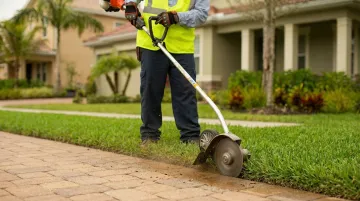
A lawn edger uses a vertical rotating blade (or sharpened manual blade) to cut a clean trough along the border between grass and hard surfaces like driveways, sidewalks, or garden beds. This is functionally different from a string trimmer, which cuts horizontally to trim grass height along edges.
Functional Benefits Beyond Aesthetics:
- Prevents root intrusion by creating clean vertical walls that keep grass out of flower beds
- Creates drainage pathways beneath borders, reducing water accumulation and frost heave risks
- Eliminates overgrowth on walkways that creates trip hazards
Professional landscapers rely on edgers as a routine finish step after mowing. The National Association of Landscape Professionals benchmarks hard edging at 9,000 linear feet per hour as a standard production metric for commercial crews.
Pairing a power edger with durable steel or aluminum lawn edging creates a permanent border structure that holds edges season after season with less re-edging effort. Wolverine Tools manufactures steel and aluminum edging built specifically for that purpose — contractor-grade borders designed to hold their form with minimal re-edging over time.
Best Lawn Edgers for Clean Edges in 2026
These five edgers were selected based on real-world performance, power output, build quality, and suitability across property sizes—from professional crews to dedicated homeowners.
Echo PE-225 Gas Lawn Edger
The Echo PE-225 is a professional-grade stick edger powered by a 21.2cc two-stroke gas engine, widely trusted by landscape crews for durability and consistent cutting power. It was rated "Best Overall" by Popular Mechanics in their 2025 lawn edger testing for its ability to cut through topsoil and typical cool-season grasses without bogging down.
What sets it apart for commercial use:
- Delivers strong torque through thick, compacted soil and overgrown edges
- Adjustable depth and angle settings with a steel blade for curved or straight borders
- i-30™ starter reduces starting effort by 30%, cutting downtime between properties
| Feature | Specification |
|---|---|
| Power Source | 21.2cc two-stroke gas engine |
| Key Features | Adjustable cutting depth and angle, pro-grade steel blade, curved-shaft design, i-30™ starter |
| Best For | Professional landscapers and large residential properties requiring heavy-duty performance |
| Price | $319.99 |
Black+Decker 2-in-1 String Trimmer/Edger
The Black+Decker LE760FF is a corded electric edger that converts between string trimmer and dedicated edger mode. It's a practical, low-cost option for homeowners with smaller yards, and a reliable backup tool for crews working near power sources on detail-heavy jobs.
At a fraction of the cost of gas or cordless competitors, it handles standard residential edge-cutting without trouble. The 12-amp motor has enough power for light trenching and cutting borders around outdoor lighting. Its dual-function design also reduces what crews need to carry for smaller, mixed-task jobs.
| Feature | Specification |
|---|---|
| Power Source | Corded electric (120V AC, 12-amp motor) |
| Key Features | 2-in-1 trimmer/edger conversion, 7.5-inch blade, 3-position depth adjustment, lightweight |
| Best For | Budget-conscious homeowners with small to medium yards near a power source |
| Price | $109.00 |
Greenworks 80V 8-Inch Cordless Edger
Greenworks' 80V platform powers one of the strongest battery-powered edgers on the market, offering an 8-inch blade depth and brushless motor that rivals the cutting performance of lower-end gas models, with no fuel costs or maintenance overhead.
The brushless motor delivers 23 N·m of torque — 18% stronger than comparable 27cc gas edgers — while running at 68% lower noise levels. For professionals moving away from gas, that combination of power and quiet operation matters on jobs near occupied buildings or noise-restricted properties. The 80V system provides up to 80 minutes of runtime on a 2.0Ah battery, enough to cover most residential lots without stopping to recharge.
| Feature | Specification |
|---|---|
| Power Source | 80V lithium-ion battery (cordless) |
| Key Features | 8-inch blade depth, brushless motor, 2.25-inch maximum cutting depth, zero emissions, quick start |
| Best For | Professionals and homeowners seeking gas-level power without fuel or maintenance overhead |
| Price | $199.00–$219.99 (tool only) |
Earthquake Walk-Behind Edger
The Earthquake walk-behind edger is a heavy-duty, wheeled edger powered by a 79cc four-cycle engine, built for large properties and commercial work where straight, deep cuts over long distances are required.
Mounted on four wheels for maximum stability, it produces the straightest, most consistent edges of any edger type — the go-to choice for restoring neglected or heavily overgrown borders. The tri-tip steel blade spins at 3,400 RPM, and the multi-position pivoting head offers 5 cutting angles from 70 to 110 degrees for sloped terrain.
Its larger footprint and price point make it overkill for small yards, but commercial landscape crews will get full use out of both.
| Feature | Specification |
|---|---|
| Power Source | 79cc four-cycle Viper gas engine |
| Key Features | Four-wheel stability, tri-tip steel blade, 3,400 RPM, multi-position pivot head (5 angles), heavy-duty construction |
| Best For | Commercial landscapers and large property owners requiring maximum cutting consistency |
| Price | $379.99–$429.99 |
Garden Weasel Edger-Chopper (Best Manual)
The Garden Weasel Edger-Chopper is a manual edger built around a heavy-gauge carbon steel blade on a 38-inch handle, built for precise spot edging without any power source. Tested and recommended by Popular Mechanics for its build quality and ease of use.
The 90-degree depth lip keeps edge depth consistent on every stroke. The wide foot plate lets you drive the blade through soil and roots using body weight, no motor needed. At just over 3 pounds, it stores easily and needs zero maintenance — a practical addition to any crew's kit for tight corners, landscape lighting installs, or work around sprinkler heads.
| Feature | Specification |
|---|---|
| Power Source | Manual (no power required) |
| Key Features | 90-degree depth guide, 8-inch carbon steel blade, 3-inch cutting depth, ergonomic T-bar handle, limited lifetime warranty |
| Best For | Detail work, tight corners, small yards, and crews needing a zero-maintenance backup tool |
| Price | $34.99–$49.99 |

How to Choose the Right Lawn Edger
Edger Type Comparison
Choose the right edger type based on property size and use case:
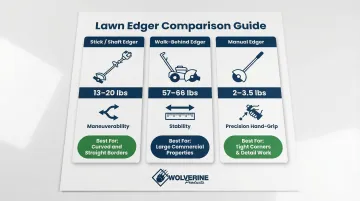
| Edger Type | Primary Use Case | Weight Range | Cutting Consistency |
|---|---|---|---|
| Stick/Shaft | Standard residential maintenance; curved/straight borders | 13–20 lbs | High consistency; requires steering practice |
| Walk-Behind | Large properties; commercial trenching; heavy overgrowth | 57–66 lbs | Maximum straight-line stability; cleanest cuts |
| Manual | Small yards; tight curves; noise-restricted areas | 2–3.5 lbs | Precise placement; requires physical effort |
Stick edgers offer the best balance of maneuverability and power for most residential and light commercial work. Curved borders are no problem, though straight-line runs take practice to master.
Walk-behind edgers deliver the straightest, most consistent cuts over long distances—ideal for commercial properties or edge restoration on neglected lawns. That weight and bulk rules them out for small yards or anything requiring detail work.
Manual edgers excel in tight spots where powered equipment can't reach—around landscape lighting, sprinkler heads, or curved flower beds. Zero maintenance and exact placement are the payoff for the extra physical effort.
Power Source Options
Match your power source to property size and workflow:
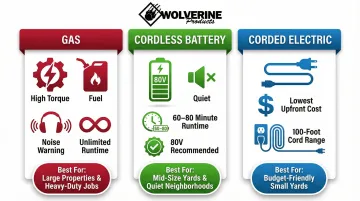
Gas:
- Unlimited runtime—no battery swaps or extension cords
- Highest torque for compacted soil and overgrown edges
- Requires fuel, oil changes, air filter cleaning, and blade sharpening
- Noise levels exceed 85 decibels—hearing protection required
- Best for: Professional crews doing multiple properties daily
Cordless Battery:
- Quick start with no pull cord or fuel mixing
- Zero emissions and 68% quieter than gas models
- Limited runtime—typically 60–80 minutes per battery
- Voltage matters: 40V minimum for serious use; 80V for commercial-grade torque
- Best for: Residential properties and professionals doing 3–5 properties per day
Corded Electric:
- Unlimited runtime as long as power is available
- Lowest upfront cost and zero fuel expenses
- Limited by cord reach—typically 100 feet maximum
- Best for: Small to medium yards near power outlets
Blade Depth and Angle Adjustment
Adjustable cutting depth lets one machine handle light maintenance and full restoration cuts on overgrown borders. Residential use needs at least 2 inches of depth; commercial crews need 2.5–3 inches for serious restoration work.
Angle-adjustable blades give you precise control on sloped driveways or crowned walkways. Multi-position pivot heads (like the Earthquake's 5-angle system) make clean edge definition possible even on uneven terrain.
Weight and Ergonomics
For professional crews covering multiple properties per day, these factors determine how your body holds up by the end of the shift:
- Padded, curved-shaft handles on stick edgers reduce arm and shoulder strain
- Harness compatibility spreads load for extended use
- Vibration dampening prevents hand fatigue on longer runs
- Walk-behind models (57+ lbs) give superior stability on straight runs but are harder to transport and store
Safety Essentials
Operating powered lawn edgers requires strict safety protocols:
- Eye protection - OSHA 29 CFR 1910.133 mandates eye protection (ANSI Z87.1) with side shields due to flying debris
- Footwear and clothing - Wear sturdy, closed-toe footwear and long pants to protect against debris
- Hearing protection - OSHA requires hearing protection when noise exceeds 85 decibels (standard for gas engines)
- Bystander safety - Keep bystanders and pets at least 50–100 feet from the operating area
- Pre-operation inspection - Clear the edging path of sprinkler heads, landscape lighting, and debris before starting; inspect blade and blade guard before each use
Conclusion
The right lawn edger depends on three variables: property size, desired edge quality, and whether you prioritize power, portability, or cost. Professionals should lean toward gas or high-voltage cordless models (80V+) for reliable daily use, while homeowners with smaller yards can achieve excellent results with corded electric or manual edgers.
Powered edging is only half of the equation. Permanent landscape edging installed along borders dramatically reduces how often power edging is needed and keeps lines sharper between sessions. Wolverine Tools manufactures steel edging, aluminum edging, and paver restraints used by landscaping contractors nationwide, designed to hold borders permanently and reduce the need for constant re-edging.
Wolverine's landscape edging products are available through wholesale landscape suppliers, garden centers, and local hardware stores. All products carry a lifetime warranty against manufacturer defects.
Frequently Asked Questions
What is the best grass edge tool?
For most users, a gas stick edger like the Echo PE-225 is the top performer for power and durability. High-voltage cordless edgers (80V+) work well for those avoiding fuel, while manual edgers suit smaller yards and detail work.
Do lawn edgers really work?
Dedicated lawn edgers create cleaner, more defined edges than string trimmers—particularly on compacted or overgrown borders. Beyond appearance, proper edging improves drainage and controls root intrusion into hardscape.
What is the difference between a lawn edger and a string trimmer?
A string trimmer cuts horizontally to trim grass height along edges. A lawn edger cuts vertically to create a defined trough between grass and hard surfaces. They serve complementary but different functions.
How often should I edge my lawn?
Most homeowners edge two to four times per growing season. Aggressive grass types like Bermuda and St. Augustine require weekly edging during peak growth due to their stoloniferous growth habits that spread aggressively across hardscape.
Is a gas or battery lawn edger better for professionals?
Gas edgers remain the standard for professional crews—unlimited runtime, higher torque, and no reliance on charging infrastructure make them hard to beat. That said, 80V+ cordless models now deliver near-gas performance for residential work without the emissions or upkeep.
How do I maintain a lawn edger after use?
After each use, remove grass and soil buildup from the blade and housing. Gas models require regular oil checks, air filter cleaning, and blade sharpening. Battery models need batteries stored in cool, dry conditions to maximize lifespan.