Introduction
Every landscaper knows the frustration: you're three hours into a project, furrows only half-finished, and your hoe blade is flexing like a diving board with every stroke. The wrong tool doesn't just slow you down—it turns a straightforward digging job into backbreaking labor that leaves your crew exhausted and your timeline blown.
Garden hoes built specifically for digging differ fundamentally from lightweight weeding hoes. Digging hoes feature heavy-duty blades (forged carbon or chromoly steel), robust handles (ash, hickory, or reinforced fiberglass), and head designs optimized for breaking soil, drawing furrows, and moving material. Using a weeding hoe for digging tasks leads to bent blades, snapped handles, and wasted time.
This guide covers the hoe types built for serious digging, the best picks for 2026, and what separates a tool worth buying from one that fails mid-job.
Key Takeaways
- A digging hoe needs a heavy-duty forged blade, a sturdy long handle, and the right head shape (Warren, draw, or grub) matched to your task
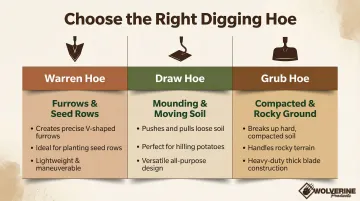
- Warren hoes excel at opening furrows and planting rows; draw hoes move and mound soil; grub hoes tackle compacted or rocky ground
- Ash or hickory handles absorb shock far better than fiberglass or composite handles
- Wolverine Tools backs every hoe with a lifetime warranty and superior materials — no replacement cycle
- Avoid cheap chain-retail hoes for demanding digging—they flex, bend, or snap under professional workloads
Types of Garden Hoes Best Suited for Digging
Not all garden hoes are designed for digging. Many retail hoes are built primarily for shallow weeding and surface cultivation. For demanding digging tasks—opening seed furrows, hilling rows, breaking compacted soil—you need a hoe with the right head style and construction.
Warren (Pointed) Hoe
The Warren hoe features a V-shaped or triangular blade with the point facing down. This design concentrates force into a narrow edge, making it the best option for digging precise planting furrows, trenches, and seed rows. The pointed blade slices cleanly into soil with minimal resistance, creating uniform channels for irrigation lines or transplant rows.
Draw Hoe
The draw hoe has a flat rectangular blade mounted at roughly 90° to the handle. You chop into the ground and pull (draw) the blade toward you to move soil. It handles the heavy lifting across landscape and agricultural digging applications:
- Building and shaping raised rows
- Mounding soil around plants
- Breaking up dense clumps during heavy cultivation
The flat blade moves significant volumes of soil per stroke, making it one of the most versatile hoes in a professional's lineup.
Grub Hoe
The grub hoe features a thick, wide blade profile designed for one purpose: breaking up hard, compacted, or rocky ground where standard hoes would bend or fail. The heavy blade drives into soil with momentum, and the reinforced construction withstands the shock of hitting rocks or roots. It's the right call when conditions are genuinely difficult—clay hardpan, construction site prep, and root-filled ground are all situations where lighter hoes simply won't hold up.
Best Garden Hoes for Digging in 2026
These picks were selected based on build quality, blade material, handle durability, task-specific performance for digging, and suitability for professional use.
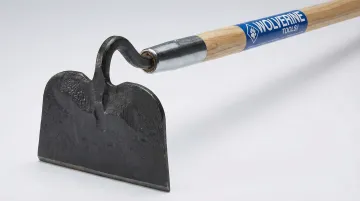
Wolverine Tools Professional Garden Hoe
Wolverine Tools is a U.S.-based manufacturer with over 30 years producing professional-grade hand tools for contractors, landscapers, and agricultural professionals. Founded in 1994, the company distributes exclusively through wholesale suppliers and garden centers, bypassing mass-market chains to maintain professional-grade standards.
The forged steel blade is produced in-house using chromoly steel — a material that outlasts the stamped carbon steel found in chain-retail tools. The ash or hickory hardwood handle absorbs shock better than aluminum or fiberglass, which matters during extended heavy digging. A lifetime warranty against manufacturer defects rounds out the value proposition for professionals who can't afford downtime from broken tools.
| Feature | Specification |
|---|---|
| Blade Material | Forged chromoly steel; stronger and more durable than standard stamped carbon steel |
| Handle Material | Ash or hickory hardwood; better shock absorption than aluminum or fiberglass handles |
| Warranty | Lifetime warranty against manufacturer defects |
Rogue ProHoe 5.75" Disc Garden Hoe
Rogue Hoe is a premium U.S. brand known for heavy-duty disc-style blades favored by market gardeners and farm professionals. The ProHoe 575G is a frequent first choice among commercial growers who prioritize edge retention over brute digging force.
The flat disc blade design excels at shallow cultivation and furrow opening. The blade is fabricated from recycled agricultural disc steel, which holds a sharp edge longer than standard carbon steel. The long 54" or 60" ash wood handle reduces back strain during extended use by allowing an upright working posture.
| Feature | Specification |
|---|---|
| Blade Style | 5.75" flat disc blade; recycled agricultural disc steel with good edge retention |
| Handle | Ash wood; available in 54" or 60" lengths for tall users |
| Best Use | Opening planting furrows and cultivating around established crops; not designed for breaking compacted or rocky ground |
Truper 30002 Warren Hoe
Truper is a widely available, value-oriented tool brand. The Warren Hoe suits contractors and small-operation growers who need a reliable pointed digging hoe without the cost of professional-grade forged steel.
The pointed Warren head opens clean seed furrows and planting holes efficiently. The welded head construction holds up in lighter garden soils, though it won't stand up to heavy clay or rocky ground the way a forged blade will. For moderate-use applications, it delivers reliable performance at a lower price point.
| Feature | Specification |
|---|---|
| Blade Style | 4.75" Warren (V-pointed) blade with clear-coated gray steel |
| Handle | North American Ash; 54" length |
| Best Use | Seed-row furrow opening and light-to-medium soil cultivation; best value for small-scale or occasional professional use |
Bully Tools Grub Hoe
Bully Tools is a U.S.-based manufacturer known for heavy-duty, American-made garden and construction tools. Their grub hoe is designed for users who regularly work in tough, compacted, or rocky soil.
The wide forged blade handles heavy digging loads without flexing, and the fiberglass handle adds shock resistance for sustained use on hard ground. When ordering, confirm the grub hoe model number directly with your supplier — SKU 92308 in some retail databases refers to a discontinued 16" asphalt rake, not this tool.
| Feature | Specification |
|---|---|
| Blade Style | Wide grub/cutter mattock-style head with 7-gauge steel construction |
| Handle | Fiberglass for shock resistance and durability |
| Best Use | Breaking compacted soil, hard clay, and rocky ground; ideal for heavy-duty landscaping and site prep |
Corona GT 3060 Forged Warren Hoe
Corona is a professional horticulture and landscape tool brand with a long industry track record. The GT 3060 Forged Warren Hoe is designed for professional growers and landscapers who need precision digging tools that hold up under daily use.
Forged heat-treated carbon steel gives the Warren-point blade strong edge retention and accurate furrow work. The extendable aluminum handle (18–32") is purpose-built for raised beds and tight spaces, though it transmits more shock than hardwood during heavy digging. Corona backs the GT 3060 with a lifetime warranty.
| Feature | Specification |
|---|---|
| Blade Construction | Forged heat-treated carbon steel Warren head; grain-aligned forging for greater strength than stamped blades |
| Handle | Extendable aluminum 18-32" with twist-lock mechanism |
| Best Use | Precision furrow digging, transplant hole preparation, and professional nursery or raised bed applications |
What to Look for When Choosing a Garden Hoe for Digging
The single biggest mistake buyers make is selecting a hoe based on price or appearance without matching the head type and build quality to the specific digging task. This leads to bent blades, broken handles, and tools that are quickly replaced.
Blade Material and Construction
Forged steel aligns the metal's grain flow parallel to the direction of applied force, offering superior fatigue resistance compared to stamped sheet metal. Forged steel is the strongest option and holds an edge under heavy load.
Stamped blades are cut and bent from flat steel sheets. They flex and dull faster under digging loads. Stainless steel resists rust but is harder to sharpen and less ideal for heavy digging than high-carbon or chromoly steel.
For professional use in compacted soil or rocky ground, look for forged high-carbon steel (1060) or chromoly steel (4130) blades. These materials provide the hardness and toughness needed to withstand daily abuse.
Handle Material and Length
Three main handle materials dominate digging hoes:
Ash or Hickory Hardwood — Traditional, shock-absorbing, and repairable; requires seasonal oiling.
Fiberglass — Lightweight, corrosion-resistant, and more durable than wood in wet conditions; cannot be repaired if cracked.
Aluminum — Lightest option, but transmits vibration directly to hands and arms. Not recommended for heavy digging.
Handle length should allow upright working posture. For most adults, a 54–60" handle reaches between armpit and shoulder height, reducing lower-back extension by up to 16.5% compared to short-handled tools.
Blade Head Type and Width
Match blade head type to task:
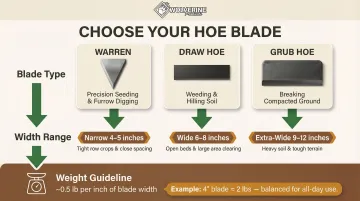
- Warren/pointed: Furrows and seed rows
- Draw/flat: Mounding and moving soil
- Grub/wide: Compacted ground breaking
Wider blades (6–8") move more soil per stroke — better for large areas, but they require more force. Narrower blades (4–5") provide precision for row crops and tight plant spacing.
For heavy digging, aim for roughly 1/2 pound per inch of blade width — for example, a 4" blade at approximately 2 pounds. That mass does the work, driving into soil rather than relying solely on arm strength.
Weight and Balance
Head weight helps, but balance determines how long you can use it. A poorly balanced hoe fatigues the user faster than a lighter, well-balanced one.
Test the tool by holding it at the handle's midpoint. The head should feel substantial but not tip-heavy. For professional all-day use, proper balance reduces cumulative fatigue over hundreds of strokes.
Build Quality Markers to Inspect
Physical indicators separate professional-grade hoes from retail-grade ones:
Blade-to-Handle Attachment:
- Solid socket or eye-hole (handle fits inside metal collar) — best for heavy chopping and digging
- Tang-and-ferrule (shank driven into handle) — prone to splitting under downward loads; suitable for pulling tasks only
Blade Construction:
- Forged: smooth, uniform steel with no visible seams
- Stamped: casting lines visible, thinner cross-sections throughout
Warranty Length:
- Lifetime warranty — signals manufacturer confidence in materials and construction
- 1-year or no warranty — the tool likely won't survive professional use
Tips for Using a Garden Hoe for Digging
Getting the most out of a digging hoe comes down to technique, maintenance, and timing. A few straightforward habits make a noticeable difference in both performance and tool life.
Technique:
- Hold the handle near vertical when driving into soil — the opposite of weeding, where the handle stays near horizontal
- Drive with body weight, not arm strength alone
- Use short, overlapping strokes to break soil evenly
Keep the blade sharp. A dull hoe skates off hard soil instead of biting in, multiplying your effort. Sharpen the beveled edge with a mill bastard file before each season and during heavy-use periods — it removes material quickly while leaving a clean, polished edge.
Choose the right conditions. Slightly moist soil (not saturated, not bone dry) cuts easiest. Digging into dry, compacted ground increases effort significantly and accelerates wear — this is where professional-grade blade construction pays off in real terms.
After each use, clean the blade to prevent rust. At season's end, apply boiled linseed oil to carbon steel blades and wooden handles. The oil cures overnight, forming a protective barrier against moisture that prevents rust and handle cracking.
Conclusion
The best garden hoe for digging is not a one-size-fits-all decision. The right choice depends on soil type, task (furrows vs. mounding vs. breaking compacted ground), and how frequently and hard the tool will be used.
For landscapers, contractors, and nursery professionals, a professional-grade hoe with forged or chromoly steel blades, hardwood or fiberglass handles, and a lifetime warranty reduces long-term tool costs significantly. Tools that bend or break after a season cost more to replace than a professional-grade option bought once.
That standard is exactly what Wolverine Tools' professional-grade garden hoe line is built to meet. Available through wholesale landscape suppliers, garden centers, and local hardware stores, these tools are designed in-house, manufactured with chromoly steel, aircraft aluminum, and ash or hickory hardwoods, and backed by a lifetime warranty against manufacturer defects.
To learn more or find a distributor near you:
- Phone: 1-800-787-3562
- Email: info@wolverinehandtools.com
Frequently Asked Questions
Frequently Asked Questions
What is the best hoe for a garden?
The best hoe depends on the task. Dutch or stirrup hoes excel at weeding, Warren and draw hoes are ideal for digging furrows and moving soil, and grub hoes break compacted ground. Build quality—forged blade and hardwood handle—matters more than brand for longevity.
Who makes the best quality garden tools?
High-quality tool makers prioritize in-house manufacturing, superior raw materials (chromoly steel, ash or hickory hardwood), and solid warranties. Professional-grade brands like Wolverine Tools are built for contractors and landscape professionals and sold exclusively through trade and wholesale channels rather than mass-market retailers.
What tools do professional gardeners use?
Professionals rely on core hand tools including draw hoes, Warren hoes, stirrup hoes, spades, and cultivators. They prioritize tool weight, balance, handle length, and blade durability over price because these factors directly impact productivity and reduce fatigue during all-day use.
What is the difference between a draw hoe and a Dutch hoe?
A Dutch hoe has a flat open blade pushed forward just below the soil surface for weeding. A draw hoe has a flat blade at roughly 90° to the handle used in a chopping/pulling motion, making it better suited for moving soil, building rows, and digging.
What should I look for in a garden hoe handle?
Three key factors matter for digging:
- Length: 54-60" allows upright posture for most adults and reduces back strain
- Material: Ash or hickory absorbs shock best for heavy digging; fiberglass is a durable lightweight alternative
- Attachment: Solid socket attachment outlasts ferrule-and-tang for demanding tasks
How do I maintain and sharpen a garden hoe?
Sharpen the beveled blade edge with a mill bastard file at the start of each season and as needed during use. Clean the blade after each use to prevent rust. Oil carbon steel blades and wooden handles with boiled linseed oil at season's end to prevent rust and cracking.