Introduction
Every contractor knows the cost of grabbing the wrong trenching tool: a round-point shovel that bends under pressure in hardpan clay, or a $400-per-day ride-on trencher rental for a 20-foot irrigation run. These mismatches burn labor budgets and push project timelines off track.
Trenching is a core task in landscaping, irrigation, drainage, utility installation, and construction. The U.S. landscaping market alone is projected to reach $188.8 billion in 2026, while fiber broadband deployments hit a record 11.8 million new home passings in 2025. With this surge in infrastructure work, tool choice directly affects project speed, labor cost, and finish quality.
This guide breaks down the best trenching tools for 2026 by soil type, trench depth, and job scale — so you can match the right tool to the work and keep projects moving.
Key Takeaways
- Hand tools (drainage spades, trenching hoes) handle runs under 40 feet, tight spaces, and precision work
- Power trenchers take over for longer, deeper, or high-volume jobs where hand tools slow you down
- Walk-behinds cut 100 feet in 30–60 minutes; ride-ons cut the same distance in 15–30 minutes
- Chromoly steel blades and fiberglass handles outperform cheap alternatives and prevent mid-job failures
- Mismatching tool to soil type or depth doubles labor time — getting this right drives every other efficiency gain
What Are Trenching Tools and Why the Right One Matters
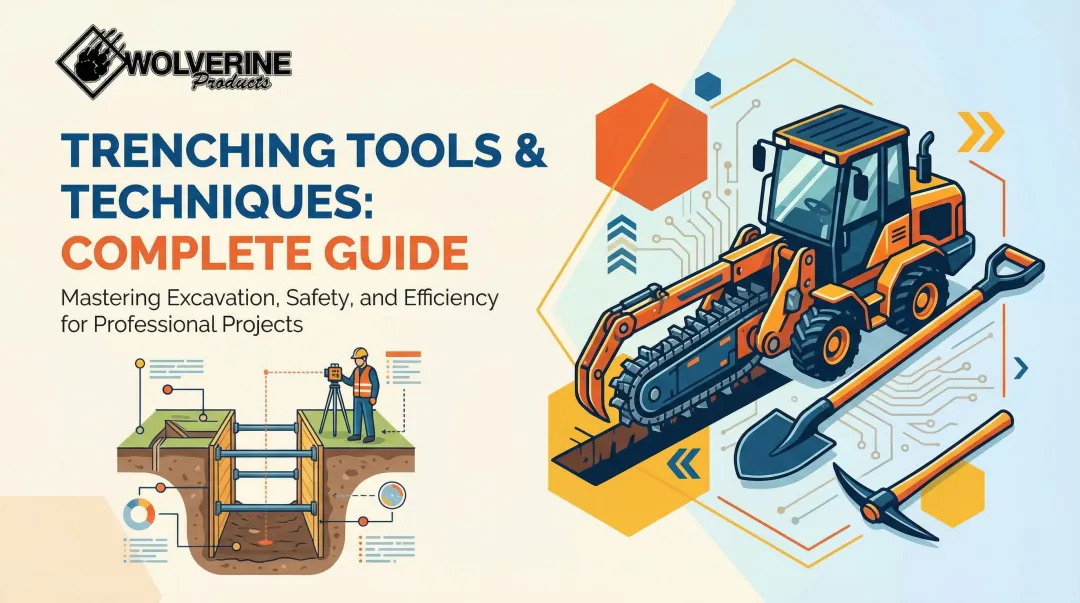
Trenching tools are any instrument—manual or powered—used to excavate a narrow channel for utilities, drainage pipes, irrigation lines, edging, or cable installation. They range from simple hand-operated spades to sophisticated chain-driven machines capable of cutting four-foot-deep channels in a single pass.
Tool selection determines how fast and cleanly a job gets done. Using a round-point shovel where a drainage spade is needed wastes effort and produces ragged edges; grabbing a general-purpose spade for a deep utility trench means unnecessary re-digging. Depth requirements vary significantly by application:
- 6–12 inches — low-voltage wire, irrigation laterals, and shallow edging runs
- 18–24 inches — residential water mains and standard drainage lines
- Up to 48 inches — direct-buried fiber optic cable and deep utility conduit
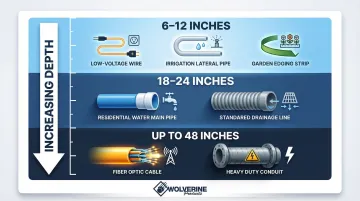
The five tools below cover the most effective options for professional contractors and landscapers in 2026, matched to the applications where each performs best.
Best Trenching Tools for Faster Projects in 2026
These tools were selected based on digging efficiency, material durability, versatility across soil conditions, and overall value for professional use.
Drainage Spade (Sharpshooter Shovel)
The drainage spade is a long, narrow-bladed shovel designed for shallow rough trenches up to 12 inches deep and 5 inches wide. It's the go-to starting tool for irrigation lines, sprinkler systems, low-voltage landscape lighting, and downspout drainage runs.
The narrow round point penetrates sod, hard-packed soil, and rocky ground with minimal effort, creating a fast entry channel without multiple passes. The blade produces a rounded bottom—ideal for flexible tubing, though not suitable for flat-pipe installations requiring a level bed.
Professional-grade drainage spades feature 14-gauge tempered steel blades with reinforced fiberglass or hardwood handles. Wolverine Tools' contractor-grade drainage spades use chromoly steel and fiberglass handles with solid reinforcing cores, built specifically for repeated professional use without the handle failures common in hardware-store alternatives.
| Specification | Details |
|---|---|
| Ideal Depth Range | Up to 12 inches |
| Best For | Irrigation lines, flexible utility tubing, downspout drainage, low-voltage wire |
| Key Material Spec | 14-gauge tempered steel blade with reinforced fiberglass or hardwood handle |
Trenching Hoe (Grub Hoe)
The trenching hoe is a heavy-duty chopping hoe that cuts flat-bottomed trenches up to 24 inches deep and 4–6 inches wide. It replicates the cutting action of a power chain trencher in a manual, controlled form—and it's the only hand tool that reliably reaches 24-inch depth.
It creates the flat-bottomed channel required for drainage pipe and French drain systems. Key design features that make it effective at depth:
- Available in 4-inch and 6-inch wide head sizes to match trench specs
- Heavy-duty head weight generates chopping force with each stroke
- Extended handle length provides leverage and distributes lower-back strain on deep runs
| Specification | Details |
|---|---|
| Ideal Depth Range | Up to 24 inches |
| Best For | French drains, drainage pipe installation, deeper utility runs |
| Key Differentiator | Heavy-duty head weight and long handle length for leverage at depth |
Trench Digging Shovel + Clean-Out Shovel
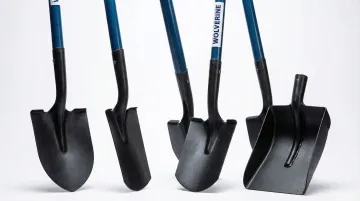
This two-tool pairing is essential for professional job sites. The trench digging shovel (step-trench style, 4 inches wide, up to 18 inches deep) cuts initial narrow channels, while the clean-out shovel (high-angle handle, walled head) removes loose spoil from the trench bottom after powered trenching.
Power trenchers leave loose crumbs at the bottom. A clean-out shovel is required before pipe laying to ensure a level, compacted bed—skipping this step leads to callbacks. The step platform on the digging shovel allows boot-pressure to drive the blade deep, while the high handle lift angle on the clean-out shovel reduces bending fatigue on long runs.
Wolverine Tools manufactures trenching shovels with 14-gauge heat-treated chromoly steel blades in multiple widths (3, 4, 5, and 6 inches), featuring closed-back design with forward-turned steps for convenient lift angle and efficient spoil removal.
| Specification | Details |
|---|---|
| Trench Digging Shovel Depth | Up to 18 inches |
| Clean-Out Shovel Use Case | Post-powered-trenching spoil removal for pipe prep |
| Pro Tip | Look for high handle lift angle on clean-out shovel to reduce bending fatigue |
Walk-Behind Trencher
Walk-behind trenchers are gas or electric-powered chain-digging machines that cut trenches up to 3–4 feet deep and 4–8 inches wide in a single pass. The operator walks backward as the rear-mounted chain engages the soil.
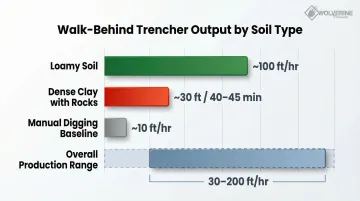
They dramatically outpace hand tools on runs over 30–40 feet and are available at most equipment rental yards. Production rates vary significantly by soil type:
- Loamy soil: ~100 linear feet at 18-inch depth per hour
- Dense clay with rocks: as little as 30 feet per 40–45 minutes
- Overall range: 30–200 linear feet per hour vs. ~10 feet per hour for manual digging
| Specification | Details |
|---|---|
| Typical Depth Capacity | 3 to 4 feet (some models up to 48 inches) |
| Available Chain Widths | 4", 6", 8" (wider for French drain gravel bed applications) |
| Best Use Case | Irrigation systems, utility runs, drainage on open-access residential or commercial properties |
Ride-On Trencher / Skid Steer Trencher Attachment
Ride-on trenchers (tractor-style, self-propelled) and skid steer trencher attachments are the heavy-duty option for large commercial or infrastructure projects. They're capable of 4+ feet depth (some models up to 6 feet) and up to 12-inch chain width, preferred by utility contractors and large-scale landscapers.
The productivity advantage is substantial. Ride-on units achieve 200 to 800 feet per hour, maintaining speed in compacted clay or rocky conditions where walk-behinds stall. Under optimal conditions, 100 feet takes 15–30 minutes. That output comes with real requirements, though:
- Operator experience and, in many cases, formal certification
- Transport equipment to move the machine between sites
- Significant site clearance — skid steer attachments especially need open terrain
Rental yards commonly restrict ride-on units to professional operators with documented training.
| Specification | Details |
|---|---|
| Depth Capacity | 4+ feet (some models up to 6 feet) |
| Best For | Large irrigation systems, utility infrastructure, commercial drainage, French drain systems requiring wide chains |
| Access Consideration | Requires open terrain; skid steer attachments need operator certification for safe use |
Hand Tools vs. Power Trenchers: Which Should You Use?
Use hand tools when:
- Trench run is under 40 feet
- Access is tight (near walls, existing hardscape, or tree roots)
- Depth is under 18–24 inches
- Precision or clean edges matter
- Budget doesn't justify rental costs ($200–$400 per day for powered equipment)
Use powered equipment when:
- Runs exceed 40–50 feet
- Depth exceeds 24 inches
- Volume and timeline demand mechanical speed
- Soil conditions make manual digging impractical
Soil type is the second critical variable. Hard clay, caliche, or rocky soil increases manual labor exponentially. In these conditions, even short runs may justify a walk-behind. With hourly labor rates for hand digging ranging from $50 to $90 per hour, manual excavation of 100+ feet quickly becomes cost-prohibitive. Loamy or sandy soil is manageable by hand for most residential landscaping jobs.
That said, hand tools stay on site regardless of what powered equipment shows up. Clean-out, precision corners, tight spots, and trench prep before pipe laying all require quality manual tools.
Tool construction matters on multi-day jobs. Blade and handle quality—steel grade, handle material—affects fatigue and longevity. Chromoly steel blades and fiberglass handles hold up under sustained use, avoiding the cost and downtime of a tool failure mid-project.
How We Chose the Best Trenching Tools
Tools were assessed on:
- Digging efficiency per soil condition — penetration in clay, rocky ground, and loam
- Depth and width versatility — matching code requirements (6" for lighting, 24" for irrigation under paving, 48" for fiber)
- Material durability — blade steel grade, handle material and reinforcement
- Ergonomics for sustained professional use — handle angle, step design, weight distribution
- Overall cost-of-ownership — not just sticker price
Contractors and landscapers often buy on price alone, underestimating what tool failure actually costs on the job. A broken handle or bent blade mid-project means lost time, emergency replacements, and potential liability. Industry data consistently shows tradespeople replace tools multiple times a year — a recurring expense that quietly erodes project margins.
Tools built with professional materials — chromoly steel, pultruded fiberglass handles, hardwoods like ash — hold up where lower-grade options fail. That's why tools from manufacturers like Wolverine Tools, who have built to these specifications since 1994, consistently make the shortlist for professional crews. Their lifetime warranty against manufacturer defects reflects what that material commitment actually means in practice.
Conclusion
The right trenching tool—matched to project scale, soil type, trench depth, and site access—is the difference between a job that runs on schedule and one that stalls. Walk-behind trenchers cut 100 feet in 30–60 minutes; ride-on units cover the same distance in 15–30 minutes. Hand tools, though, aren't just backup equipment.
For short runs, tight access, or precision work, a high-quality drainage spade, trenching hoe, or trench shovel from a professional manufacturer will outperform both cheap alternatives and oversized powered equipment. Material quality matters: 14-gauge chromoly steel blades and pultruded fiberglass handles with solid reinforcing cores eliminate the replacement costs and mid-job failures common with hardware-store tools.
Wolverine Tools has built professional-grade hand tools—chromoly steel blades, pultruded fiberglass handles, ash and hickory hardwoods—since 1994, and distributes exclusively through wholesale landscape suppliers, garden centers, and local hardware stores nationwide. For contractors who want to see what's available, wolverinehandtools.com or 1-800-787-3562 are good starting points.
Frequently Asked Questions
What do plumbers use to dig a trench?
Plumbers typically use a drainage spade (sharpshooter shovel) for shallow utility runs, a trench digging shovel for narrow, deeper channels, and walk-behind or ride-on trenchers for longer runs. The short-handled drainage spade is particularly common among plumbers working in confined spaces like basements or crawl spaces.
How long does it take to trench 100 feet with a trencher?
A walk-behind trencher cuts 100 feet in roughly 30–60 minutes depending on soil conditions and chain width; a ride-on unit covers the same distance in 15–30 minutes. In dense clay or rocky soil, production rates drop significantly for both machine types.
What is the best hand tool for digging a narrow trench?
A trench digging shovel (step-trench style, 4 inches wide) is ideal for narrow flat-bottomed channels up to 18 inches deep, while a drainage spade suits quick, shallow rough trenches. Match the tool to the bottom profile needed: drainage spades for flexible tubing runs, trench shovels for rigid pipe beds.
What is the difference between a drainage spade and a trench shovel?
A drainage spade has a narrow, round-pointed blade for penetrating hard soil and creating rough-bottomed trenches up to 12 inches deep. A trench digging shovel has a flat, rectangular blade designed for precise flat-bottomed channels up to 18 inches deep.
Can you use a regular garden shovel for trenching?
A standard round-point or flat garden shovel is inefficient for trenching because the blade is too wide, creating oversized spoil and ragged edges. Specialized trenching tools (drainage spades, trench shovels, grub hoes) are shaped specifically to cut narrow, clean channels with far less effort—typically 4–6 inches wide compared to 8–10 inches for standard shovels.
What trenching tool works best in rocky or hard soil?
A drainage spade with a thick 14-gauge steel blade handles initial penetration best, paired with a pick or mattock to break up rocks and roots first. For extensive hard-soil runs, a powered chain trencher reduces labor and tool damage risk significantly.