Introduction
Uneven terrain costs professional landscapers more than time—it damages equipment, triggers drainage failures, and loses contracts. A single grading error can consume 5% to 10% of total project budgets through rework. Field corrections drive 52% of overall cost growth and push average schedule delays to 19%. For contractors in 2026, the right leveling equipment is the difference between profitable projects and costly do-overs.
The landscape leveling category has expanded from basic hand rakes to laser-guided land planes and hydraulic-adjustable rear blades. The gap between professionals and amateurs often comes down to one decision: matching the right tool to the job.
A box scraper excels at aggressive cut-and-fill work but falls short on finish grading. A professional-grade hand rake delivers precision in tight spaces that no machine can replicate.
This guide breaks down the best landscape leveling equipment available in 2026—covering which tools handle rough grading versus finish work, what separates professional-grade from contractor-grade, and how to match equipment to job conditions before costs get away from you.
Key Takeaways
- Job scale and terrain type determine whether you need hand tools, tractor attachments, or both
- Prioritize steel grade, handle durability, attachment compatibility, and total cost of ownership
- Landscape rakes are irreplaceable for finish grading, seed bed prep, and tight-access detail work
- Box scrapers, rear blades, and land planes are built for large-scale commercial grading
- Professional-grade tools eliminate the replacement costs and on-site failures that plague consumer-grade alternatives
What Is Landscape Leveling Equipment and Why It Matters in 2026
Landscape leveling equipment encompasses the full range of tools—hand-operated and machine-mounted—used to grade, smooth, and redistribute soil to achieve uniform, functional surfaces across residential, commercial, and agricultural sites. These tools address a real problem: improper grading causes drainage failures, erosion, structural damage, and costly rework.
According to the Navigant Construction Forum, the median direct cost of rework on capital improvement projects ranges from 4.03% to 6.05% — and once indirect costs are factored in, the total burden climbs to 7.25%–10.89% of original contract costs.
On a $50 million, two-year project, that translates to roughly 72 days of delay and over $1.9 million in extended overhead and liquidated damages.
Investing in precision leveling equipment keeps those costs off the table. The right tools:
- Prevent drainage failures before they require costly correction
- Eliminate surface irregularities that trigger structural issues down the line
- Produce grades that pass inspection the first time, cutting callbacks and rework
Best Landscape Leveling Equipment in 2026
These picks represent the range of tools professionals rely on: selected for durability, performance consistency, and real job-site value across different scales of work.
Landscape Leveling Rake (Hand Tool)
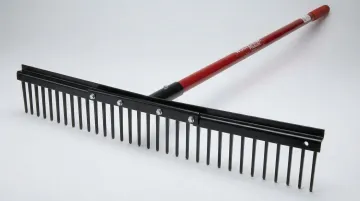
A professional-grade landscape leveling rake is the most versatile tool in any landscaper's kit. Used for spreading topsoil, leveling seed beds, removing debris, and achieving finish grades that machines can't replicate in tight or detailed spaces, these rakes separate professional operations from amateur work.
Wolverine Tools has manufactured professional hand rakes since 1994, offering steel landscape rakes with heat-treated steel heads and aluminum landscape rakes constructed from aircraft aluminum. Models range from 18" to 48" widths, with handle options including North American Ash hardwood, steel, and powder-coated aluminum. The company backs all landscape rakes with a lifetime warranty against manufacturer defects—a benchmark worth comparing competitors against.
What differentiates professional leveling rakes from hardware store versions:
- Heat-treated steel or aircraft aluminum tines with up to 50% more material than standard rakes
- 4-bolt head attachment systems provide superior stability over single-pin consumer designs
- Handle options — powder-coated aluminum, ash hardwood, or steel — resist cracking under torque unlike hollow aluminum or composite alternatives
- Widths from 18" to 48" handle soil distribution across varying job scales
- Lifetime warranty coverage against manufacturer defects signals confidence in long-term durability
| Feature | Professional Standard |
|---|---|
| Head Design | Wide-head designs (18"–48") for efficient soil distribution; tines should be heat-treated steel or aircraft aluminum to resist bending under load |
| Handle Material | Powder-coated aluminum, ash hardwood, or steel—avoid hollow aluminum or composite handles that crack under torque |
| Best For | Final-pass grading, seed bed prep, topsoil spreading, detail work around hardscape edges, and tight spaces machines cannot reach |
Box Scraper (3-Point Hitch Tractor Attachment)
The box scraper is the go-to tractor attachment for rough grading on medium to large properties. Front and rear cutting edges work in both forward and reverse passes, making it efficient for leveling driveways, building pads, and uneven turf areas.
Commercial-grade box scrapers feature hardened scarifier teeth for breaking compacted soil, reinforced steel A-frame construction, reversible double-beveled cutting edges, and compatibility with both Cat I and Cat II 3-point hitch systems. Standard-duty models with 3/8" A-frames handle up to 45-50 HP, while heavy-duty models use 1/2" A-frames and accommodate 70-120 HP tractors.
Professional models universally feature dual (forward and reverse) 1/2" x 6" high-carbon, heat-treated, reversible cutting edges. Commercial units include 4 to 8 adjustable scarifier shanks — typically 3/4" x 2-9/16" x 18" heat-treated spring steel — with replaceable hardened tips for ripping hardpan.
| Feature | Commercial Standard |
|---|---|
| Typical Width Range | 48" to 96" across standard and heavy-duty models; wider models require Cat II hitches and higher horsepower |
| Construction Standard | High-carbon steel cutting edges, hardened scarifier teeth, reinforced A-frame; heavy-duty models use 1/2" A-frames vs. 3/8" standard duty |
| Best For | Driveway grading, landscape grading, leveling building pads, cutting into compacted soil, aggressive material transfer |
Rear Blade / Grader Blade
A rear blade (also called a grader blade) is one of the most versatile tractor attachments for landscape professionals. It grades roads, pushes soil, cleans up construction debris, backfills trenches, and plows light snow — a genuine multi-season attachment on commercial properties.
Key performance differentiators include 360-degree blade pivoting capability, multiple forward and backfill angle positions, blade thickness, and whether it uses hydraulic or manual angle adjustment. Commercial models offer hydraulic angle, tilt (up to 30°), and offset (up to 35") kits, allowing operators to make on-the-go adjustments without leaving the cab—eliminating downtime from manual pin adjustments.
Construction quality matters:
Professional rear blades feature 5/16" moldboards with 1/4" boxed reinforcements and weigh between 1,130 and 1,753 lbs to prevent bouncing over hard-packed material. Heavy-duty models use Grade 80 steel for extended service life on rocky or hard-compacted terrain.
| Feature | Commercial Standard |
|---|---|
| Blade Angle Range | Manual models: 5-7 forward/5 reverse positions; hydraulic models: up to 60° adjustment with on-the-go control from cab |
| Blade Material | 5/16" high-carbon steel or heat-treated steel with boxed reinforcements; blade thickness affects longevity on rocky terrain |
| Best For | Road grading, backfilling, site cleanup, snow clearing, general-purpose leveling across large areas, ditching operations |
Tow-Behind Drag Leveler / Lawn Leveler
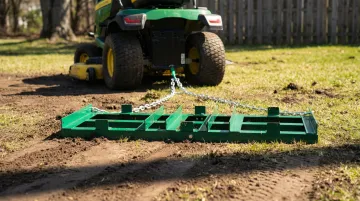
Tow-behind drag levelers are the preferred tool for lawn-scale leveling. Pulled behind ATVs, compact tractors, or utility vehicles, they're ideal for smoothing ruts, filling low spots, and leveling turf before overseeding — common applications in both residential landscaping and sports turf maintenance.
Construction considerations that matter for professional use include frame gauge (heavier steel resists flex on uneven terrain), drag mat or blade design, adjustable fill box depth, and tow hitch compatibility. Professional models require only 14-35 HP (ATV/UTV/Mower) and use 2" ball/pin hitches, making them accessible for operations without heavy tractor fleets.
Professional features:
Commercial tow-behind units feature adjustable ripping teeth that loosen material up to 1-3/4" to 7" deep to eliminate potholes and compaction. Optional fill-box attachments give ATV-scale equipment "extra earth-moving muscle," allowing operators to quickly level driveways, collect loosened debris, and fill in low areas. Electric actuator kits enable operators to control wheel-lift systems directly from the tow vehicle seat.
| Feature | Commercial Standard |
|---|---|
| Frame Construction | Heavy-gauge steel frames (336-800+ lbs depending on width) resist flex on uneven terrain; frame rigidity affects leveling accuracy |
| Fill Box / Blade Design | Adjustable fill boxes allow soil redistribution in a single pass; pivoting rake and scarifier combinations break up compaction while leveling |
| Best For | Lawn leveling, rut repair, pre-seeding prep, sports turf maintenance, filling low spots across large turf areas without heavy tractor weight |
Land Plane / Grading Scraper
The land plane is the heavy-duty, precision leveling attachment for contractors working on larger earthmoving projects. It uses a long, rigid frame with front and rear blades to shave high spots and fill low areas in a single pass, producing a consistently flat surface suited for building pads, food plots, driveways, and large landscaped areas.
Land planes differ from box scrapers through their longer frame length (up to 62"), which improves leveling accuracy across uneven terrain by creating an "averaging effect" that spans dips and humps. Manufacturers note that land planes require significantly fewer passes than box blades to achieve finish-grade surfaces.
Frame length and horsepower matching:
Commercial land planes range from 48" to 96" widths with frame lengths of 50" to 62". Standard models handle up to 50 HP; heavy-duty models accommodate 90 HP.
Unlike box scrapers designed to capture and transfer large volumes of dirt, land planes process material through dual parallel grading blades at 5–10 degree angles. That design reduces the horsepower demand and eliminates the constant 3-point lift adjustments box scrapers require to hold grade.
| Feature | Commercial Standard |
|---|---|
| Frame Length | 50" to 62" frame lengths improve grade accuracy over varying terrain; longer frames create averaging effect that reduces passes required |
| Horsepower Requirement | Standard models: up to 50 HP; heavy-duty models: 65-90 HP; match tractor HP to land plane size for optimal performance |
| Best For | Building pad prep, food plots, large driveway leveling, precision finish grading on commercial landscaping projects, road maintenance |
How We Chose the Best Landscape Leveling Equipment
Equipment was assessed across four critical dimensions: material quality and build durability, compatibility with real-world professional workflows, total cost of ownership, and performance consistency across varying soil and terrain conditions.
A common mistake buyers make is choosing based on upfront price alone, only to face repeated tool failures that cost more in downtime and replacements. The Institute for Supply Management notes that "TCO vs purchase price analysis often reveals higher upfront options as more cost-effective over time due to lower energy use, fewer failures, and higher residual value."
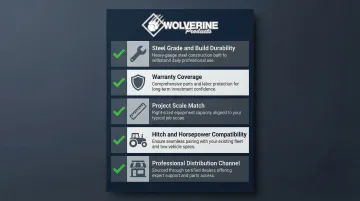
Key selection criteria applied:
- Evaluate steel grade, handle material, frame thickness, and cutting edge hardness for build durability
- Confirm warranty coverage — lifetime against manufacturer defects outperforms limited 1-2 year policies
- Match tool capacity to your typical project scale and use frequency
- Verify hitch category (Cat I vs. Cat II), horsepower requirements, and hydraulic remote compatibility
- Choose professional distribution channels over consumer retail — contractor-grade tools are built to handle daily commercial demands
Every criterion above points to the same conclusion: build quality determines total value. Professional-grade tools use heat-treated steel, aircraft aluminum, and reinforced A-frames — construction that holds up where thinner-gauge consumer alternatives break down under commercial use.
Conclusion
The best landscape leveling equipment in 2026 isn't defined by one tool—it's a combination of the right machine-mounted attachments for scale efficiency and professional-grade hand tools for precision and finish work. Skimping on either category shows up fast: in downtime, rework, and tools that don't make it through a full season.
Evaluate tools not just on specs but on build quality, warranty backing, and whether the manufacturer understands professional use cases. The wrong choice is expensive in predictable ways:
- A box scraper with a 3/8" A-frame will fail under 70 HP loads
- A consumer-grade rake will bend on compacted soil
- A rear blade without hydraulic adjustment costs hours in manual repositioning across a single project
Professional landscapers and contractors can find Wolverine Tools' professional-grade hand tools—landscape rakes, contractor shovels, and specialty digging tools built from chromoly steel, aircraft aluminum, and hardwood handles—through wholesale landscape suppliers, garden centers, and local hardware stores nationwide. For direct assistance locating distributors or product information, reach out to info@wolverinehandtools.com or call 1-800-787-3562.
Frequently Asked Questions
What is the best tool for leveling a large landscape area?
Large-scale leveling typically requires a tractor attachment — box scraper, rear blade, or land plane — while a tow-behind drag leveler works well for large turf areas. The right choice depends on the goal: rough grading (box scraper), road work and backfilling (rear blade), or precision finish grading (land plane).
What is the difference between a box scraper and a rear blade?
A box scraper uses front and rear cutting edges to cut and move soil in both directions, making it ideal for aggressive grading and material transfer. A rear blade is better for pushing and spreading material, offers more angle versatility for road work and general cleanup, and excels at backfilling and ditching operations.
Do professional landscapers still use hand rakes for leveling?
Yes, professional landscape rakes remain essential for finish grading, seed bed preparation, and detail work in areas machines cannot reach. The key is using a professional-grade rake with heat-treated steel or aircraft aluminum heads and durable handles rather than consumer-grade versions that bend or break under load.
How do I choose between a tow-behind drag leveler and a grading scraper?
A drag leveler is best for turf-scale leveling (rut repair, pre-seeding prep) and works with ATVs or small tractors, protecting sensitive turf from heavy equipment damage. A grading scraper (land plane) suits larger earthmoving and precision finish grading on harder or more uneven terrain, requiring 50-90 HP tractors.
What materials should I look for in professional landscape leveling tools?
Prioritize these material combinations:
- Rake heads and tines: heat-treated steel
- Scraper and blade cutting edges: hardened high-carbon steel
- Handles: powder-coated aluminum, ash hardwood, or steel
These hold up under daily professional use far longer than untreated steel or hollow composite alternatives.
How often do landscape leveling tools need to be replaced?
Professional-grade tools with proper materials and construction should last many seasons without replacement, especially when backed by a lifetime warranty against manufacturer defects. Consumer-grade tools often fail within one or two seasons. If a brand offers a lifetime warranty, that's a concrete signal they stand behind the build quality.