Introduction
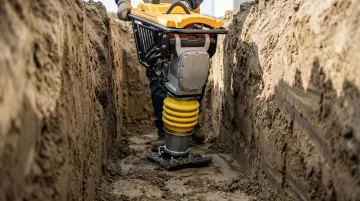
Clay soil is notoriously unforgiving under the wrong compactor. Its cohesive, fine-grained structure resists standard vibratory methods, and trapped moisture creates unstable foundations when equipment isn't matched to the soil type. Unlike granular soils that respond well to vibration, clay requires impact-based or kneading-action compaction to break particle bonds and expel air voids.
Choosing the wrong compactor leads to poor load-bearing capacity, surface heaving, and expensive project rework. When field density tests fail, contractors face delays, wasted material, and client dissatisfaction.
This guide covers the five best compactors for clay soil in 2026 — from vibratory rammers for tight trench work to padfoot rollers for large-scale grading — so you can match the right machine to your project before the first pass.
Key Takeaways
- Vibratory rammers deliver the high-impact blows needed to compact clay effectively
- Standard plate compactors fail on pure clay because vibration alone causes pumping, not densification
- Impact energy (measured in kN or lbf) and shoe size determine clay compaction performance
- Padfoot rollers provide kneading action for larger open subgrades
- Moisture management at optimum content is critical; no compactor can fix poor site prep
Why Clay Soil Demands Specialized Compaction Equipment
The Physics of Cohesive Soil
Cohesive soils like clay and silt behave differently from granular soils such as sand and gravel. Clay particles bond tightly together through molecular attraction and hold water within their structure.
Apply high-frequency, low-amplitude vibration—the mechanism that works well on gravel—to saturated clay, and you risk a phenomenon called "pumping." The soil liquefies rather than densifies, building up rapid pore-water pressure that destroys shear strength instead of compacting.
Two Mechanisms That Actually Work
Clay requires one of two specialized compaction approaches:
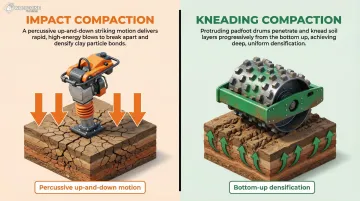
Impact Compaction uses sharp vertical blows that shear clay particles apart, break cohesive bonds, and expel trapped air. Vibratory rammers (jumping jacks) deliver this high-amplitude impact force through a percussive up-and-down motion.
Kneading Compaction uses repeated penetration and release, as seen with padfoot (sheepsfoot) rollers. The protruding drum feet create high contact pressure, penetrating the clay surface to compact from the bottom up while creating an interlocking, densified mass.
Standard forward plate compactors—designed for granular soils—are largely ineffective on pure clay because they lack both mechanisms.
The Cost of Getting It Wrong
Using the wrong compactor on clay produces measurable, costly failures. Proctor density tests (ASTM D698 and D1557) set the industry standard for maximum dry density and optimum moisture content—and underpowered equipment consistently fails them. Common outcomes include:
- Inadequate compaction depth that leaves soft zones below the surface
- Soil rebound after the machine passes, negating the work done
- Failed density tests that trigger rework and project delays
- Damaged contractor reputation on inspection-required jobs
Clay must be compacted at or near its optimum moisture content (OMC). Too dry, and it resists compaction; too wet, and water-filled voids weaken load-bearing capacity. No amount of equipment power compensates for poor moisture management.
Best Compactors for Clay Soil in 2026
These five machines are selected based on compaction mechanism suitability for cohesive soils, impact energy output, durability under demanding field conditions, and professional contractor adoption.
Wacker Neuson BS60-4s Vibratory Rammer
Wacker Neuson equipment is found on job sites from road construction to utility trenching worldwide. The BS60-4s is their flagship rammer, built for reliable performance on cohesive soils including heavy clay, and widely used on foundation prep and trench backfill.
Why it stands out for clay: The BS60-4s delivers 18 kN (4,047 lbf) of impact force at 656-690 blows per minute through a 280 x 340 mm shoe. This combination provides the deep, percussive force needed to compress clay layers effectively without rebound. The premium 4-stage air filter ensures dust-free operation in dry clay conditions, while the shock-mount guide handle reduces hand-arm vibration to 6.5 m/s² for operator comfort during long shifts.
| Specification | Details |
|---|---|
| Engine / Power Source | Honda GXR 120, 2.7 kW (3.6 hp) @ 4,100 rpm |
| Impact Force | 18 kN (4,047 lbf) at 656-690 blows/min |
| Shoe Size / Weight | 280 x 340 mm (11 x 13.4 in), 72 kg (158 lbs) operating weight |
Mikasa MTX70HDR Vibratory Rammer
Mikasa (a Multiquip brand) is trusted among landscape and site-prep contractors. The MTX70HDR is a Honda-powered rammer positioned as a workhorse for cohesive soil applications at a professional price point.
What differentiates this model: The MTX70HDR delivers 14.9 kN (3,350 lbf) of impact force at up to 690 blows per minute through a 13.4 x 11.2-inch shoe. Its large shoe footprint distributes force effectively across clay surfaces, while the low center of gravity improves stability on uneven terrain. The cyclonic air cleaner captures 98% of airborne dust particles, and the laminated wood-and-steel shoe absorbs shock to extend service life. Low-vibration handles and tool-free service access make it a practical daily-use machine for contractor crews.
| Specification | Details |
|---|---|
| Engine / Power Source | Honda GXR120, 3.6 HP (2.7 kW) @ 4,100 rpm |
| Impact Force | 14.9 kN (3,350 lbf) at up to 690 BPM |
| Shoe Size / Weight | 13.4 x 11.2 in (340 x 285 mm), 165 lb (75 kg) operating weight |
Multiquip MTX80HDR Rammer
Multiquip is a major North American equipment manufacturer. The MTX80HDR is positioned as a heavy-impact rammer designed for demanding cohesive soil applications including dense clay and mixed clay-silt substrates.
Why contractors choose this model for heavy clay: The MTX80HDR delivers 15.6 kN (3,507 lbf) of impact force with a stroke length of 2-3.15 inches at up to 678 blows per minute. Its heavier 181-pound operating weight increases penetration depth per blow compared to lighter rammers, making it ideal for dense clay layers. The 13.4-inch shoe width provides a balance between impact concentration and production speed. Tool-free maintenance access and a durable laminated shoe reduce downtime on demanding job sites.
| Specification | Details |
|---|---|
| Engine / Power Source | Honda GXR120RTKRBF, 3.6 hp (2.7 kW) @ 3,600 rpm |
| Impact Force | 15.6 kN (3,507 lbf), 2-3.15 in stroke length, up to 678 BPM |
| Shoe Size / Weight | 13.4 x 11.2 in (340 x 285 mm), 181 lbs (82 kg) operating weight |
Husqvarna LG 504 Reversible Plate Compactor
Husqvarna's compaction line includes the LG 504, a high-force reversible plate compactor that bridges the gap between standard plates and rammers. It's viable for clay-gravel mix soils or clay subgrades that have been broken up or conditioned with moisture management.
Important clarification: Reversible plate compactors are not ideal for pure dense clay but become effective when clay content is mixed with granular material or when working on shallow lifts. The LG 504 delivers 65 kN (14,612 lbf) of centrifugal force through a 550 mm (27.56-inch) wide plate, making it suitable for semi-cohesive sand-clay mixes.
The Hatz diesel engine provides 9.1 kW of power, and the 470 kg operating weight ensures adequate ground pressure. Husqvarna notes this model is designed to "efficiently compact deep and medium-deep granular soil" and serves as an alternative to rollers in confined areas.
| Specification | Details |
|---|---|
| Engine / Power Source | Hatz 1D81Z Diesel, 9.1 kW |
| Centrifugal Force / Plate Size | 65 kN (14,612 lbf), 550 mm (27.56 in) plate width |
| Operating Weight / Travel Speed | 470 kg (1,093 lbs), 32 m/min travel speed |
Bomag BW 65 H Walk-Behind Padfoot Roller
Bomag manufactures compaction equipment used across civil construction, earthworks, and site-prep applications worldwide. The BW 65 H (with padfoot shell attachment) is the go-to option for contractors needing to compact larger clay areas—such as subgrade preparation for driveways, parking areas, or structural fill pads—where a rammer would be too slow.
Why padfoot drums work for clay: The padfoot (sheepsfoot) drum mechanism is engineered specifically for cohesive soils. Protruding feet penetrate the clay surface layer, knead the soil beneath, and create a tightly interlocked compacted mass.
The BW 65 H delivers 22 kN (4,946 lbf) of centrifugal force through a 650 mm (25.6-inch) drum width, covering far more area per pass than a rammer. The 757 kg operating weight provides the static pressure needed for deep penetration. Bomag notes that padfoot shells increase surface area, penetrate clay to knead it, and accelerate subgrade drying—critical for maintaining optimum moisture content during compaction.
| Specification | Details |
|---|---|
| Engine / Power Source | Hatz 1D 42 Diesel, 6.2 kW (8.3 hp) @ 2800 rpm |
| Drum Width / Compaction Force | 650 mm (25.6 in) drum width, 22 kN (4,946 lbf) centrifugal force |
| Operating Weight | 757 kg (1,669 lbs) |
How We Chose the Best Compactors for Clay Soil
Evaluation Framework
Each compactor was assessed against five criteria:
- Compaction mechanism compatibility with cohesive soils
- Impact energy or centrifugal force output
- Engine reliability and serviceability
- Professional contractor adoption rates
- Manufacturer support and parts availability
The most common mistake contractors make is choosing based on price or brand familiarity alone — without confirming the machine's compaction mechanism actually suits cohesive soil.
The Critical Role of Moisture Content
Clay compaction success depends heavily on soil moisture content. Machines that perform at optimum moisture (near Proctor optimum) require fewer passes and achieve deeper penetration. According to geotechnical engineering principles, peak density for cohesive soils occurs at a specific water content for a given compaction effort.
If clay is too dry, it shatters and resists compaction. If too wet, equipment will sink, rut, or cause the soil to pump. No compactor can compensate for poorly managed moisture conditions on site.
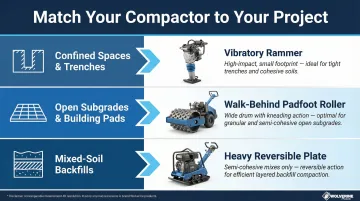
Matching Machine Type to Project Scope
Project scale matters as much as raw compaction force:
- Confined spaces & trenches: Vibratory rammers are the undisputed choice, providing high-amplitude impact in narrow utility cuts where rollers cannot fit
- Open subgrades & building pads: Walk-behind padfoot rollers cover wider footprints efficiently and use heavy static weight combined with kneading pads
- Mixed-soil backfills: Heavy reversible plates work for semi-cohesive soils (clay-gravel mixes) where high centrifugal force can achieve deep compaction, provided clay content isn't high enough to cause pumping
Effective compaction depth is limited by equipment capability and soil type. For plastic cohesive soils, thin lifts are universally required—typically restricted to 6-8 inches of loose material per pass to ensure bottom-up compaction.
Conclusion
For clay soil, impact-based rammers and padfoot rollers consistently outperform standard forward plate compactors. Choosing the right compaction mechanism is more important than choosing the most powerful machine on the market. Vibratory rammers excel in trenches, footings, and confined spaces, while padfoot rollers are better suited for open subgrade areas.
Compaction is one phase of site prep — the work before and after it matters just as much. The right hand tools speed up every step:
- Breaking up dense clay before compaction: Cap rock shovels with heat-treated chromoly steel blades that won't split under impact
- Finishing trenches and preparing lift surfaces: Contractor spades and trenching tools built for daily abuse
- Hand-tamping around foundations or in confined areas: Dirt tamps with high-carbon American steel heads
Wolverine Tools has manufactured professional-grade hand tools since 1994, building a nationwide reputation among contractors who can't afford equipment that fails mid-job. Their cap rock shovels, contractor spades, and dirt tamps are available through wholesale landscape suppliers, garden centers, and local hardware stores across the country. Find a distributor near you at wolverinehandtools.com or call 1-800-787-3562.
Frequently Asked Questions
What is the best compactor for clay?
Vibratory rammers (jumping jacks) are the best compactor type for clay soil because their high-impact blows break cohesive particle bonds and expel air voids effectively. Look for models with impact forces above 14 kN (3,000 lbf) and shoe sizes between 11-14 inches for optimal clay penetration.
Can I use a plate compactor on clay soil?
Standard forward plate compactors are largely ineffective on pure clay because vibration alone does not adequately compact cohesive soilsand can trigger pumping or liquefaction instead. Heavy reversible plate compactors can work on clay-gravel mixes but should not be the first choice for dense clay subgrades.
What is the difference between a rammer and a plate compactor?
Rammers use high-frequency impact (percussive up-and-down motion) to compact soil in a small footprint, making them ideal for cohesive soils and confined areas like trenches. Plate compactors use vibration over a larger plate area, making them better suited for granular soils like gravel and sand.
How deep can a compactor compact clay soil?
For clay, rammers typically compact in lifts of 6-8 inches — the exact depth varies with impact energy and soil moisture. Thicker lifts risk poor density at the bottom of the layer, leading to failed Proctor tests and costly rework.
Should clay soil be wet or dry when compacting?
Clay compacts most effectively near its optimum moisture content, determined by a Proctor test. Soil that is too dry becomes brittle and resists compaction, while soil that is too wet will pump and not hold density. Managing moisture before and during compaction is essential to achieving target density.
What is a padfoot roller used for?
Padfoot (sheepsfoot) rollers compact cohesive soils like clay across large open areas. Their protruding drum feet penetrate and knead the soil rather than rolling over it, making them the preferred choice for subgrade preparation on driveways, parking areas, and structural fill pads.