Introduction
Moving heavy potted plants is one of the more punishing tasks in nursery and landscape work — unstable weight, fragile containers, and repetitive lifts add up fast. Bureau of Labor Statistics data puts nursery and garden center Total Recordable Case incidence rates at 3.6 to 3.8 per 100 workers, well above the private industry average.
The right hand truck can dramatically reduce plant transport time, minimize breakage, and protect workers from back strain. NIOSH-backed research shows specialized lifting tools reduce forward bending by 47% and lifting strain by 40% — a measurable return on a straightforward equipment decision.
This guide covers the top hand trucks for potted plant transport, the features that matter most in professional settings, and how to match the right tool to your operation's workload.
Key Takeaways
- Wide, flat nose plates and rubber-grip surfaces prevent pots from slipping during transport
- Load capacity, wheel type (pneumatic vs. solid), and frame material determine whether a hand truck holds up through a full season of daily use
- Convertible hand trucks offer versatility for nurseries handling varied pot sizes
- Professional-grade models outlast consumer alternatives and reduce replacement costs
- Matching the right model to your load — from 1-gallon containers to large B&B trees — prevents damage and operator fatigue
Why Potted Plant Transport Demands a Specialized Hand Truck
Potted plants present unique transport challenges that standard appliance or warehouse hand trucks simply aren't designed to handle. The unstable center of gravity of a tall plant in a ceramic pot, combined with irregular shapes and fragile terracotta containers, creates tipping and breakage risks that generic hand trucks can't mitigate. Add wet soil and muddy outdoor conditions, and you have a recipe for damaged merchandise and worker injuries.
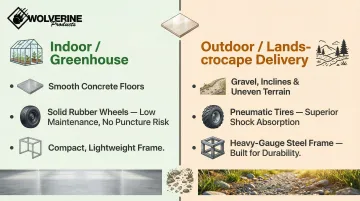
Professional nursery operations face two distinct use cases, each demanding different specifications:
- Indoor nursery and greenhouse transport: Smooth concrete floors favor compact designs with solid rubber wheels — low rolling resistance, no maintenance concerns.
- Outdoor landscape delivery: Gravel paths, inclines, and uneven terrain call for pneumatic tires. Pneumatic wheels provide superior shock absorption, protecting fragile root balls from jarring impacts that can damage plant health.
Using the wrong hand truck leads directly to broken merchandise, soil spills, and back injuries. A 5-gallon container of wet soil already weighs 58-60 lbs—exceeding NIOSH's 51-lb safe lifting limit—and a 3-inch caliper B&B tree can top 750-880 lbs. At those weights, equipment choice directly impacts both product integrity and worker safety.
Best Hand Trucks for Moving Potted Plants
These selections were evaluated on load capacity, nose plate design, wheel suitability for outdoor and indoor terrain, frame durability, and value for professional use. Each pick targets a specific use case — from high-volume nursery yards to greenhouse delivery runs — so the right choice depends on your terrain, container weights, and daily workload.
Harper Trucks Heavy-Duty Continuous Loop Steel Hand Truck
For nursery and landscape supply operations moving large ceramic or stone planters, Harper Trucks' continuous loop frame design is the standout structural feature. The added rigidity prevents frame flex under heavy loads — critical when containers can shift unexpectedly mid-move.
The deep nose plate accommodates wide pot bases securely, and the robotically welded steel construction handles daily professional use without the fatigue failures common in consumer-grade models. The curved back straps are designed for cylindrical objects, making this an ideal choice for round nursery containers.
| Feature | Specification |
|---|---|
| Load Capacity | 600 lbs (Model 59T60) / 800 lbs (Model 56T60) |
| Frame Material | Steel with continuous loop reinforcement |
| Nose Plate | 8.5" x 14" (59T60) / 9.5" x 14" (56T60), beveled edge |
| Wheels | 10" solid rubber |
| Best For | Heavy specimen pots, large nursery containers, daily high-volume use |
Magna Cart Personal Folding Aluminum Hand Truck
When vehicle storage and job-site portability matter as much as capacity, the Magna Cart MCX is the practical pick. At just 6.8 lbs, this aircraft-grade aluminum frame folds to compact dimensions of 25" x 15" x 2.5", fitting easily in car trunks or behind truck seats.
The 15" x 11" aluminum base plate provides a stable platform for medium-weight pots, and the lightweight design reduces operator fatigue during landscape delivery work. However, the 150-lb capacity means this model falls short for the heaviest loads — it's best suited for moving multiple smaller pots between a vehicle and planting site rather than large specimen trees.
| Feature | Specification |
|---|---|
| Load Capacity | 150 lbs |
| Frame Material | Aluminum |
| Weight | 6.8 lbs |
| Folded Dimensions | 25" x 15" x 2.5" |
| Best For | Medium-weight pots, landscape delivery, easy vehicle storage |
Cosco Shifter Multi-Position Folding Hand Truck & Cart
Nurseries handling both tall potted plants and wide, low planters benefit from the Cosco Shifter's convertible design. It transitions between upright hand truck mode and flat cart mode with no pins or tools required — no stopping to reconfigure mid-job.
The extendable handle and ability to convert to a platform cart mean you can transport multiple small pots in a single trip, improving efficiency in retail garden center environments. The 14" W x 5" D toe plate accommodates standard nursery containers, though the plastic wheel components and mixed steel-plastic construction show limitations under heavy daily professional use compared to all-steel alternatives.
| Feature | Specification |
|---|---|
| Load Capacity | 300 lbs |
| Frame Material | Steel with plastic components |
| Dimensions | 49.25" H x 16.62" W x 13.75" D |
| Toe Plate | 14" W x 5" D |
| Best For | Mixed pot sizes, light-to-medium commercial use, multi-functional operations |
Wesco Superlite Aluminum Hand Truck
The Wesco Superlite is built for professionals who want aluminum's weight savings without sacrificing nose plate coverage. At 11.5 lbs with a 175-lb capacity, it handles most retail nursery container sizes without the added frame weight of steel alternatives.
The 19" W x 12" D nose plate is among the widest in this category, providing excellent stability for round nursery pots. The 7" x 1.5" rubber tread tires on poly hubs perform well on smooth greenhouse floors and indoor concrete, and the unit folds to just 29.5" H x 19" W x 2" D for storage. One trade-off: no pneumatic tire option, so rough outdoor terrain is where this model reaches its limits.
| Feature | Specification |
|---|---|
| Load Capacity | 175 lbs |
| Frame Material | Aluminum alloy |
| Weight | 11.5 lbs |
| Nose Plate | 19" W x 12" D |
| Wheels | 7" x 1.5" rubber tread on poly hubs |
| Best For | Professional nurseries, greenhouse operations, indoor smooth floors |
Dutro Pro Series Heavy-Duty Hand Truck
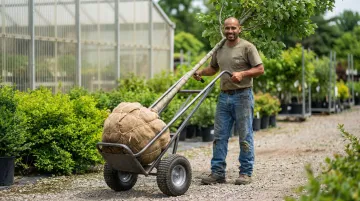
For outdoor nursery yards and rough-terrain landscape work, the Dutro Pro Series 510PNP is the purpose-built option. Dutro explicitly recommends the oversized 10" pneumatic tires for heavy loads on soft surfaces such as dirt or gravel, making it the clearest match for contractors working off paved surfaces.
The reinforced steel nose plate grips large container bases securely, and the 540-lb load rating handles B&B trees and large specimen plants with a proper safety margin. Pneumatic wheels provide the shock absorption necessary to protect root balls when rolling over mulch, gravel, and uneven ground — terrain conditions where solid wheels simply can't perform.
| Feature | Specification |
|---|---|
| Load Capacity | 540 lbs |
| Frame Material | Heavy-gauge steel |
| Wheels | 10" pneumatic |
| Terrain | Concrete, carpet, gravel, grass, dirt |
| Best For | Outdoor nursery yards, landscape contractors, large B&B and specimen plant transport |
How We Chose the Best Hand Trucks for Potted Plants
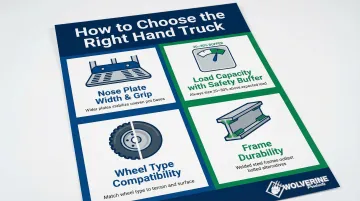
Selections were based on four primary criteria that directly impact professional nursery and landscape operations:
1. Nose plate width and surface grip determine whether pots sit securely or tip during transport. A nose plate that's too narrow for your container bases creates an unstable load, while beveled edges help slide under pot bottoms without lifting the entire weight.
2. Load capacity relative to typical container weights must account for dynamic forces. Industry guidelines recommend a 20-30% safety buffer above your heaviest expected load to handle the multiplied forces when starting, stopping, or rolling over bumps. A 5-gallon container might weigh 60 lbs, but dynamic loads during transport can stress the frame and axles as if it were 75-80 lbs.
3. Wheel type compatibility separates indoor and outdoor performance. Pneumatic tires excel on rough terrain, providing shock absorption that protects fragile root balls, while solid rubber wheels offer maintenance-free operation on smooth greenhouse floors without the puncture risk.
4. Frame durability under repeated daily stress distinguishes professional-grade from consumer-grade equipment. Continuous loop steel frames, robotically welded joints, and solid steel axles withstand years of commercial use, while consumer models with plastic components and lighter-gauge tubing fail quickly under professional volume.
Common Buyer Mistakes
The most common mistakes include choosing a hand truck based on price alone without checking nose plate dimensions, selecting solid wheels when the job site demands pneumatic tires for uneven ground, or buying a consumer-grade product that fails within months under commercial volume.
Professional landscapers and nursery operators should prioritize frame strength, wheel compatibility, and nose plate dimensions over upfront cost—those specs determine whether a hand truck survives commercial volume or gets replaced within a season.
Conclusion
The best hand truck for moving potted plants depends on your specific work environment. Smooth greenhouse floors favor lightweight aluminum models with solid rubber wheels, while outdoor nursery yards and landscape delivery sites demand heavy-duty steel frames with pneumatic tires. No single model fits every professional's needs.
Assess your most common pot sizes and weights before purchasing. A nursery moving primarily 1-gallon to 5-gallon containers has different requirements than a landscape contractor transporting 3-inch caliper B&B trees weighing 750+ lbs. Terrain matters just as much—gravel yards and grass delivery sites require pneumatic wheels, while concrete floors perform better with solid rubber.
Prioritize frame material, wheel type, and nose plate design over brand name or price alone. A $150 professional-grade hand truck that lasts five years costs less per year than a $75 consumer model that fails in 12 months.
The right hand truck is only part of the equation. Complementary equipment—nursery carts for heavy B&B stock, utility wagons, tree slings, and webbing—rounds out a safe, efficient plant-moving operation. Wolverine Tools has manufactured professional-grade nursery equipment since 1994, including Ball & Burlap carts rated to 1,600 lbs, all backed by a lifetime warranty against manufacturer defects. Available through wholesale landscape suppliers and garden centers nationwide.
Frequently Asked Questions
What weight capacity do I need in a hand truck for moving large potted plants?
Estimate total pot weight by adding soil, container, and plant mass, then choose a hand truck rated at least 25-30% above your heaviest regular load. This safety buffer accounts for dynamic forces during transport: the multiplied stress on frames and axles when starting, stopping, or rolling over bumps.
What type of wheels are best for moving potted plants on uneven outdoor terrain?
Pneumatic (air-filled) tires provide superior shock absorption and traction on gravel, grass, and uneven ground, protecting fragile root balls from jarring impacts. Solid rubber wheels work best on smooth indoor concrete or greenhouse floors where puncture risk and maintenance matter more than cushioning.
Can a regular hand truck be used for moving potted plants, or do I need a specialized one?
Standard hand trucks can work but often lack a wide enough nose plate to accommodate round pot bases securely, increasing the risk of pots tipping or slipping during transport. Specialized models with wider, deeper nose plates and appropriate wheel types perform better and reduce breakage.
How do I prevent potted plants from tipping over on a hand truck?
Three practices reduce tipping risk significantly:
- Secure the pot to the frame using bungee or load straps
- Choose a model with a deep or wide nose plate that extends well under the pot base
- Keep the center of gravity low by tilting the hand truck at a slight angle, not fully upright
Are folding hand trucks durable enough for professional nursery use?
Aluminum folding models handle light-to-medium professional use effectively, especially for landscape delivery between vehicles and job sites. However, they may not withstand the daily load stress of high-volume nursery operations, where a fixed-frame steel or heavy-duty aluminum model provides more reliable long-term performance.
What is the best hand truck for moving heavy potted trees and B&B plants?
Choose a heavy-duty steel hand truck with pneumatic tires and a wide reinforced nose plate, with load capacity exceeding the combined weight of root ball, container, and soil by at least 25-30%. For 3-inch caliper trees weighing 750-880 lbs, select models rated for 1,000+ lbs to maintain a safe dynamic load margin.